
Chapter 6: Trading tips – Practical lessons to sharpen your edge
A clear checklist is only the starting point. On a live chart, an opposing signal may appear while you are holding a position, RSI may confirm late, or the market may make a shallow pullback before resuming its prior trend. The trading tips below address these situations so you can not only identify entries but also maintain discipline as conditions change.
6.1. Do not rush to exit on an early opposing signal
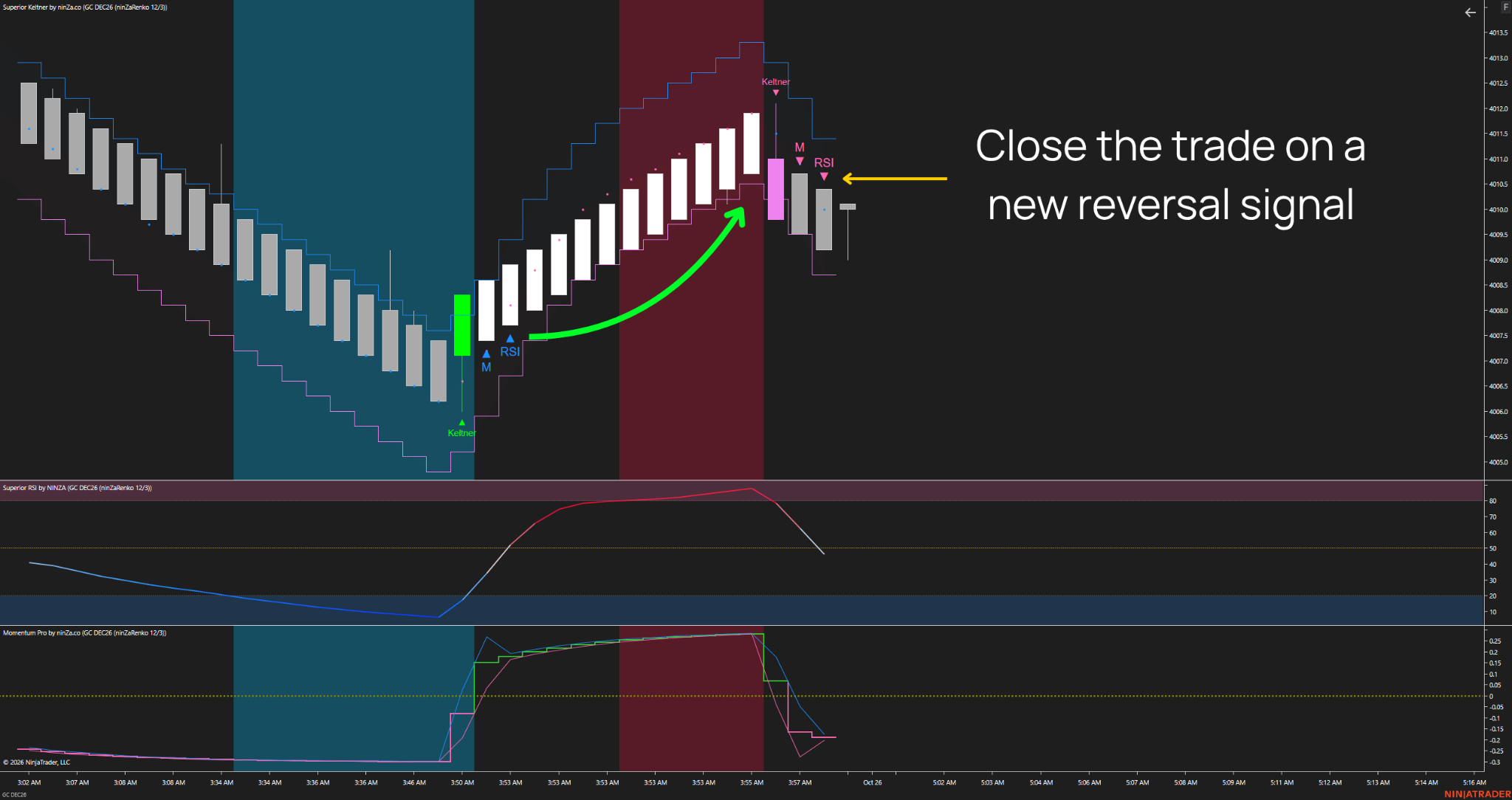
Suppose you are holding a Sell position and price continues lower as expected. After a period of decline, RSI enters OS, Superior Keltner produces a bullish reversal signal, and Momentum Plot crosses above zero. It is tempting to think, “Price may be about to rise. I should close my short now.” But if RSI has not crossed above the 50 midline, the opposing Buy setup still lacks its final confirmation. This may be nothing more than a pullback within an ongoing downtrend. Do not abandon a position on an incomplete signal simply because you are afraid of giving back open profits.
That said, “do not rush to exit” does not mean holding a trade at all costs. Your predefined stop loss, profit target, and exit plan still take priority. Price can reverse sharply before RSI crosses 50. The point is to assess opposing signals against the same checklist rather than reacting to isolated signs.
6.2. Skip a setup when the required sequence is not met
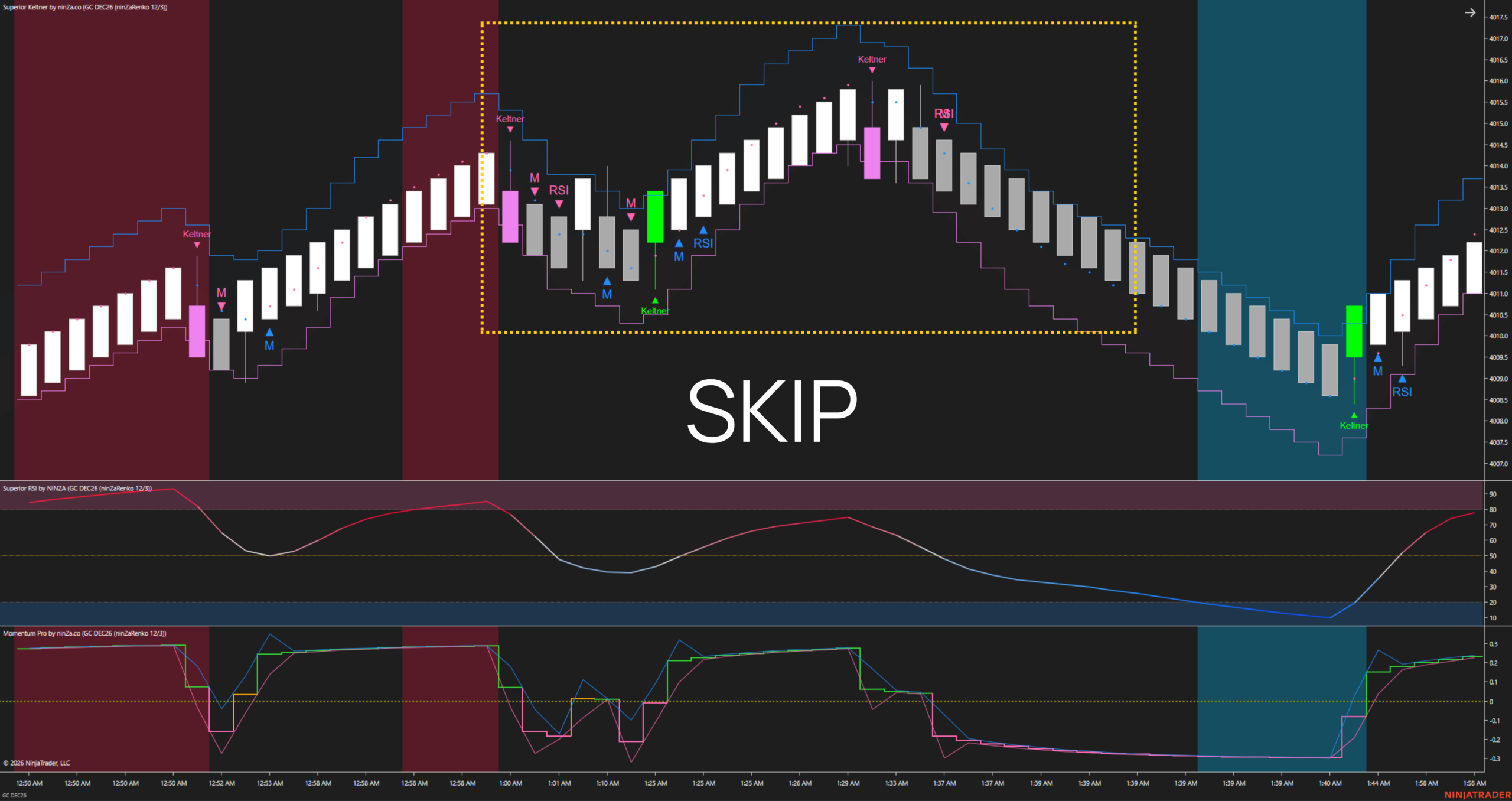
Skip the setup if any step does not occur in the required sequence. For example, a Keltner signal may appear before an RSI signal, or RSI may not signal until several bricks after Momentum. Even if the Keltner, Momentum, and RSI conditions are all met, skip the setup if the required OB/OS context is missing.
6.3. When the pullback is shallow, review market context and reversal signals carefully
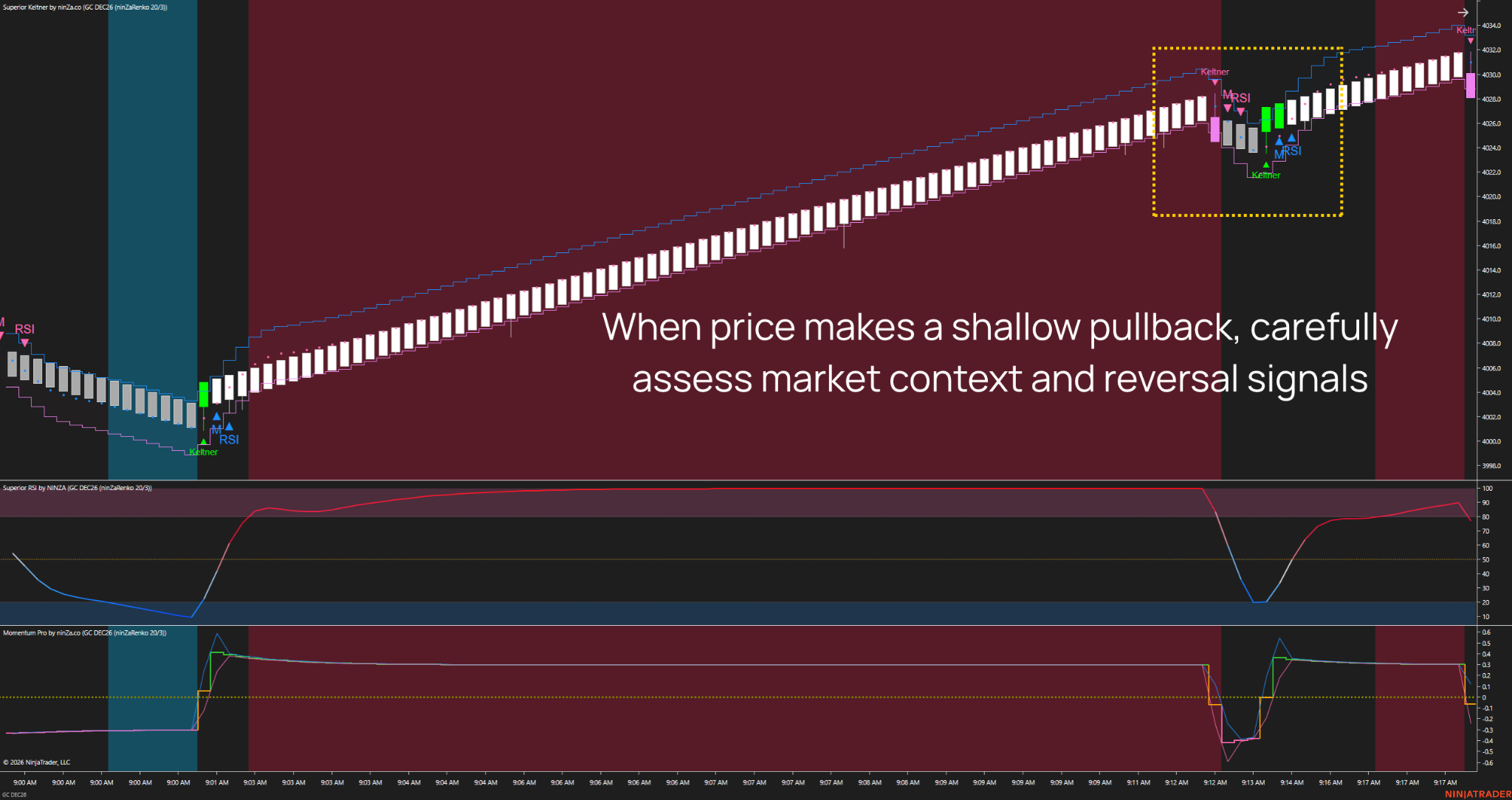
Imagine the market is in a strong uptrend. A few bearish Renko bricks suddenly appear, leading many traders to think it is time to sell the top. But price pulls back only a short distance before bullish bricks return. If selling pressure fades, this may simply be a pause in buying rather than the end of the uptrend.
In that situation, instead of defending the original Sell idea, reassess which direction is actually in control. It may be more worthwhile to watch for the uptrend to continue than to keep waiting for a deeper decline. However, do not automatically classify it as a Buy setup under this Solution. If the pullback has not taken RSI into OS, Step 1 of the Buy checklist has not been met. Trading that continuation requires a separate set of rules suited to trend-following entries.
Put simply, a shallow pullback followed by another move in the same direction is a trend-following trade after a pullback. It differs from mean reversion, where the trader expects price to return toward an average. Understanding the distinction helps you choose a strategy that fits the current price action instead of forcing every move into a reversal trade.
6.4. A market without clear direction does not always call for a trade
When Renko bricks repeatedly change color inside a narrow range, many small turns look like reversal signals. But this Solution is not designed to trade those minor fluctuations. We want to see a clear directional advance or decline, the Keltner bands sloping with that move, and RSI entering OB/OS. If price has not moved strongly enough to establish that context, looking for signals may lead to more trades without necessarily producing better results. Wait for a price move worth evaluating.
If you also use a free indicator that marks equilibrium zones, treat it as a reminder to be more selective when the market lacks momentum. This tool helps filter market context; it does not replace the 4 Buy/Sell conditions. Filtering out unsuitable periods may improve focus. Whether it improves win rate must be evaluated using actual trade history.
3 trading tips to remember
Do not rush to close a trade just because Keltner and Momentum turn against your position while RSI has not confirmed. Do not chase an entry when late RSI confirmation has made the risk-to-reward ratio unattractive. And do not try to pick a top or bottom when a shallow pullback suggests the main trend is still strong. Always prioritize your stop, target, and risk-management plan.
Continue reading → Chapter 7: Trade management – Keeping risk under control