
Chapter 2: Why traders often get reversal entries wrong
Recognizing that price has made a strong move up or down is easy. The harder part is knowing whether it is time to look for a reversal or whether price is simply pausing before continuing in its original direction. The five scenarios below explain why traders need a structured confirmation process rather than relying on the feeling that price has “moved too far”.
2.1. Entering OB/OS doesn’t mean a reversal is coming
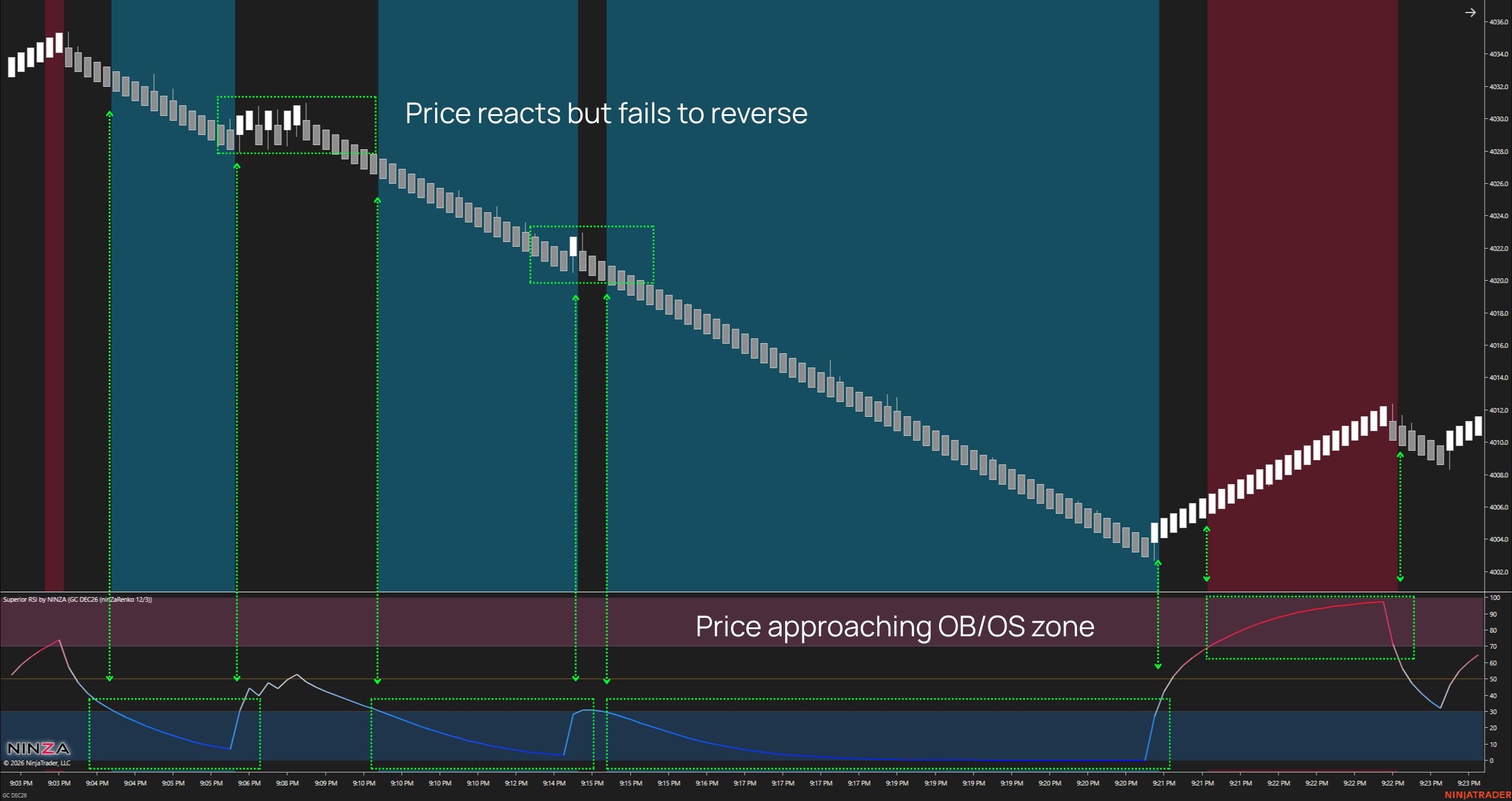
When RSI enters Oversold territory, many traders immediately think, “Price has fallen sharply. It may be ready to bounce.” When RSI enters Overbought territory, they start looking for Sell entries, assuming price has risen too far. But anyone who has traded through a strong trend knows that RSI can remain in extreme territory for an extended period while price continues to make new highs or lows. Fidelity also highlights this behavior in its explanation of how to use RSI. [5]
The mistake is not in watching OB/OS levels. It is in treating them as Buy or Sell buttons. In this solution, RSI entering extreme territory is simply a prompt to start watching the market more closely. Before entering a trade, traders still need to see a reversal response from price and work through the subsequent confirmation steps.
2.2. A few bullish bricks don’t confirm a reversal.
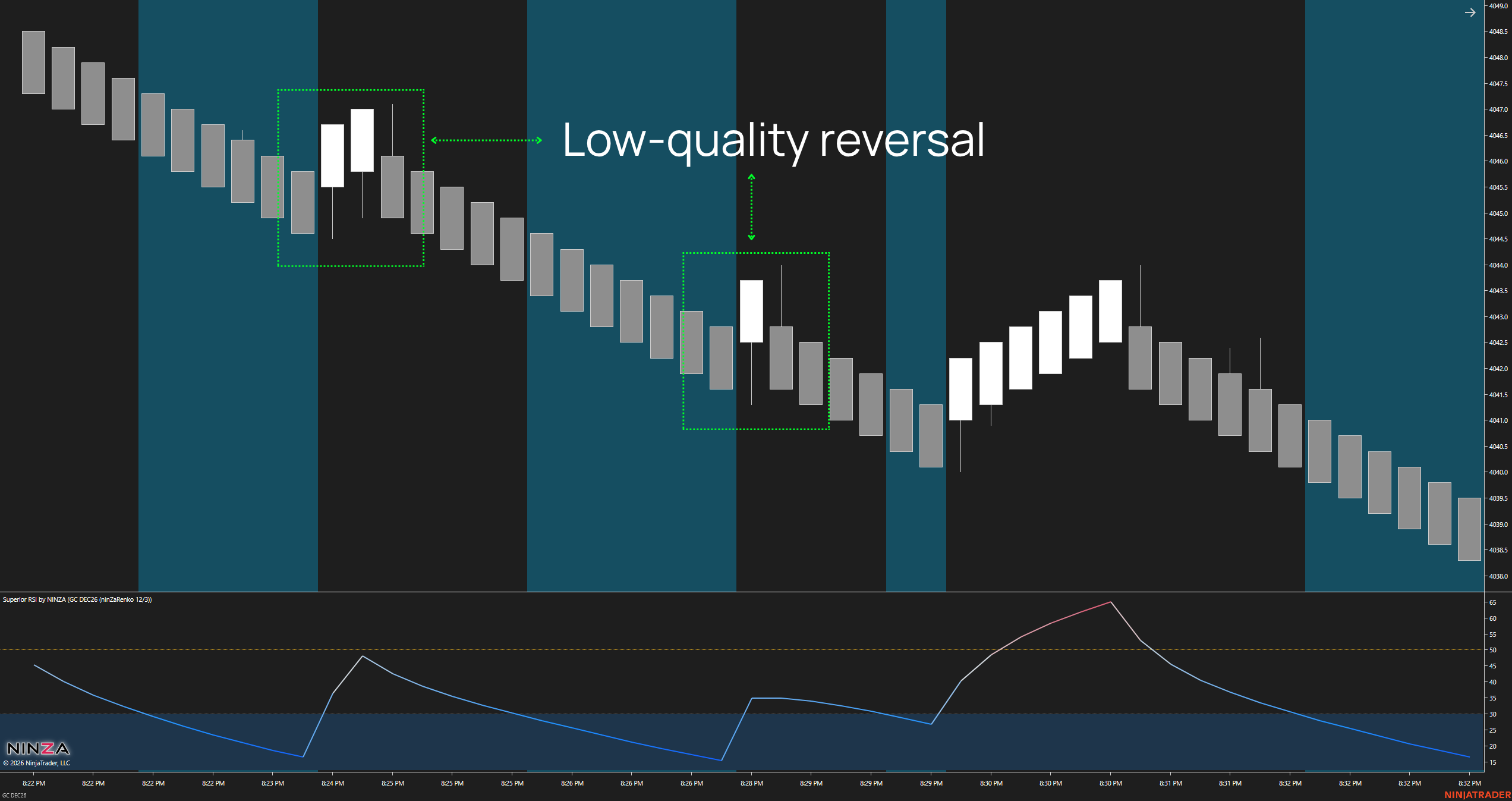
After a series of bearish Renko bricks, seeing 1 or 2 bullish bricks can easily create the impression that a bottom has formed. But price may simply be making a brief pullback before continuing lower. What traders really need to know is not whether the bricks have changed color, but whether buying pressure is strong enough to persist beyond the initial reaction. Entering a Buy too quickly at the first green brick means betting on a reversal that has not yet been confirmed.
2.3. The cost of early and late entries
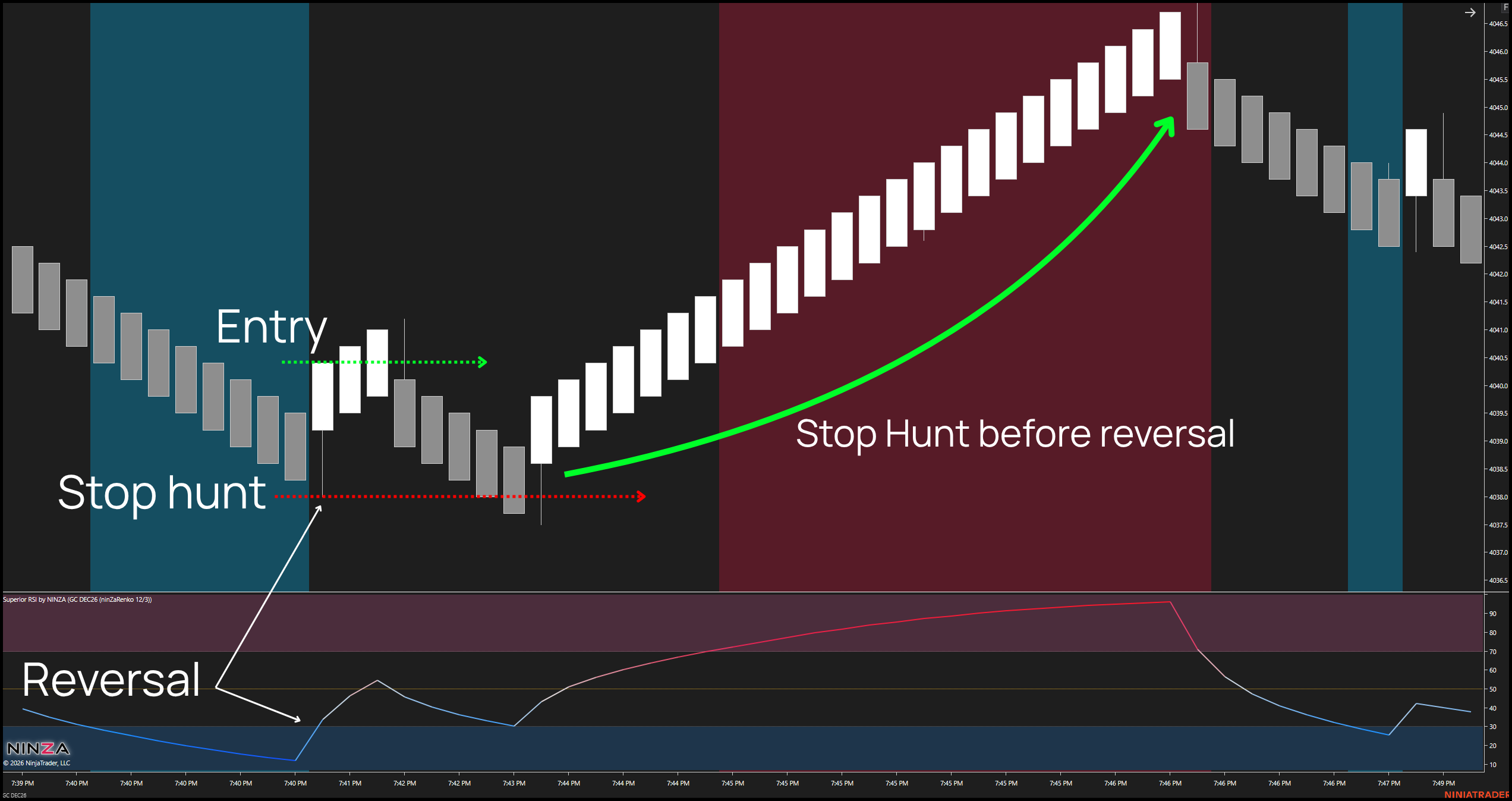
This is a very real dilemma for reversal traders. Enter too early, and price may continue in the prevailing trend and hit your Stop just before the actual reversal begins. Wait too long, and you may enter after price has already covered much of the move. At that point, the Stop is often farther away, while the remaining distance to the Target is shorter.
With Renko, a clear sequence of bricks that forms after the move is complete can make the Entry look much easier in hindsight than it was in real time. That is why a trade should be evaluated based on what the trader knew at the time of entry, not on the outcome visible afterward.
2.4. Knowing when to stay out
Many traders like to trade reversals in a ranging market, buying near the lower boundary and selling near the upper boundary. That approach has its own logic, but it is not the type of opportunity Precision OB/OS Solution is designed to prioritize.
The solution looks for a sufficiently clear directional move, reflected in the Renko brick sequence and Keltner, that pushes RSI into OB/OS territory. The focus is on potential changes in direction after a meaningful price move, not every small rise and fall within a narrow range.
With this solution, knowing when to stay out is not simply a matter of whether the market is ranging or the bricks keep changing color. The key issue is whether price has made a sufficiently clear directional move for RSI to enter OB/OS territory and for Keltner to establish the required context.
Without that initial move, a few bricks turning in the opposite direction do not constitute the kind of opportunity the checklist is designed to identify. This is also why Renko was chosen as the charting foundation, rather than simply as another way to display price bars.
Reference Note – RSI Can Remain in OB/OS Territory for Extended Periods
According to Fidelity’s RSI guide, during a strong trend, the indicator can remain in Overbought or Oversold territory for an extended period. This is why OB/OS should be used to monitor market conditions, not as an independent Buy or Sell signal.
Source: Fidelity, Relative Strength Index [5]
Continue reading →
Chapter 3: Understanding the components of Precision OB/OS Solution