1
Read the price action around the signal
Determine whether price is moving with clear direction or remains slow, choppy, and indecisive.
This prevents every visible signal from being treated as equally actionable.
Momentum-led scalping
Expansion Entry Scalping Solution helps scalpers recognize when momentum is beginning to support an entry, filter weaker setups, and make faster, more selective trade decisions.
EXCLUSIVE RENKO PERSPECTIVE
A proprietary money-flow perspective created specifically for Renko scalpers.
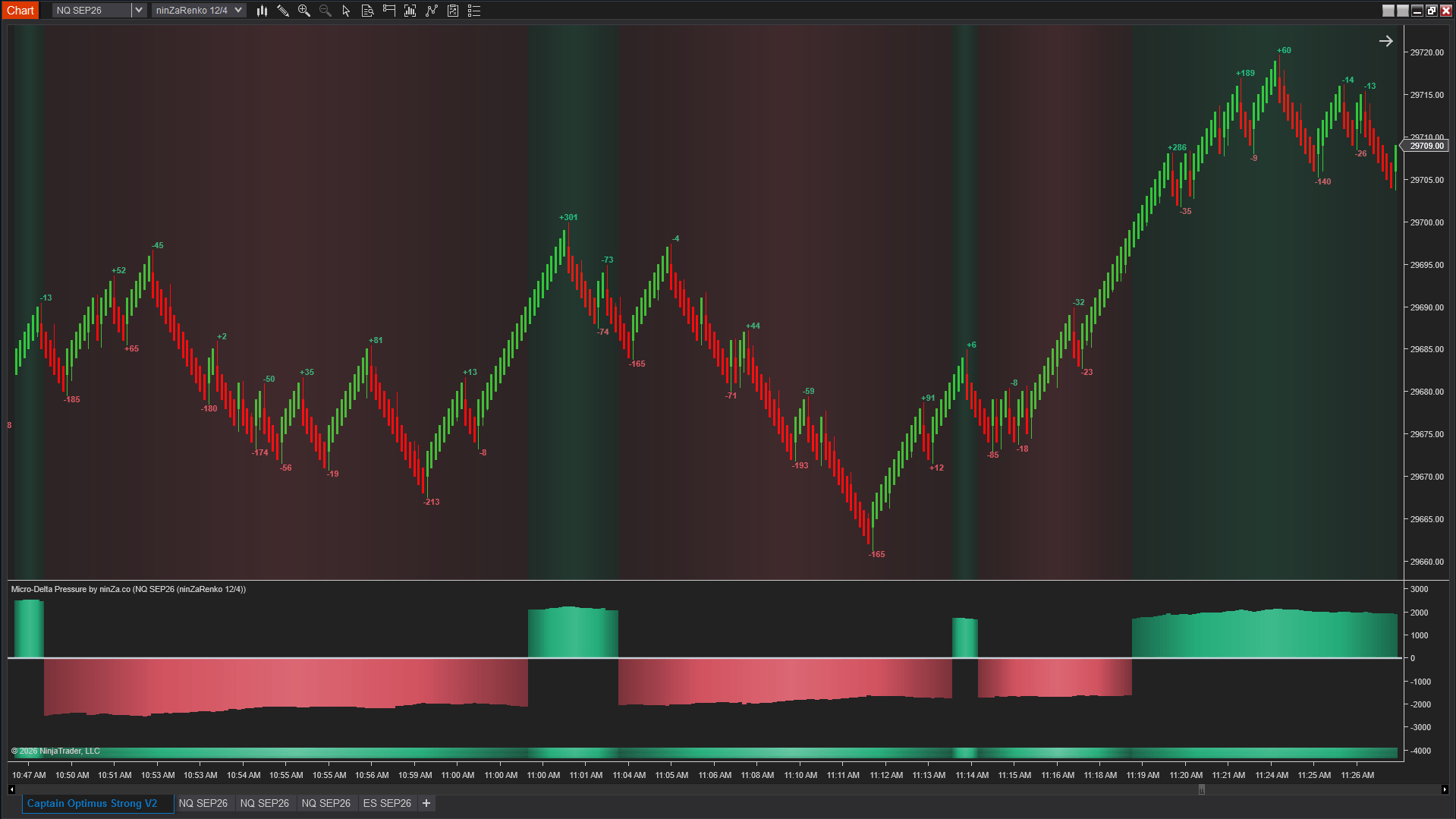
Micro Trend Dectector helps you identify the developing micro trend, assess accumulated money flow within each upward and downward swing, and gain a clearer view of longer-term directional strength.
It has not been released in the NINZA store, cannot be purchased separately, and is included exclusively with the complete Expansion Entry Scalping Solution.
The market reality
The harder part is knowing which signals are worth taking.
The same buy or sell signal can appear during a clean directional move or inside slow, choppy price action with no real commitment.
When taking a trade becomes the priority, strong and weak setups can begin to look equally actionable. Instead of waiting for the right conditions, the trader starts looking for a reason to enter.
For a scalper, that difference matters.
Without enough momentum, price may stall after entry, reverse repeatedly, or remain trapped inside a narrow range. The signal is visible, but the timely follow-through needed for a scalp never develops.
Scalpers also have limited time to evaluate each opportunity. The more time spent interpreting separate chart elements, the less attention remains for execution, risk, and trade management.
The real challenge is not finding another signal.
It is finding an entry where momentum is beginning to create a genuine opportunity for a scalp.
The momentum-first approach
A scalper does not need to capture the entire trend. A relatively small but decisive move can provide enough range for a trade.
The goal is not to predict how far the market will run. It is to determine whether momentum is beginning to support the entry now.
This changes the role of the signal.
A buy or sell signal is not treated as a complete reason to enter. It becomes the starting point for evaluating whether the surrounding price action has enough direction and strength to follow through.
Expansion Entry Scalping Solution applies this principle through a simple process.
Determine whether price is moving with clear direction or remains slow, choppy, and indecisive.
This prevents every visible signal from being treated as equally actionable.
Assess whether buying or selling pressure is becoming strong enough to support timely movement after entry.
The aim is to recognize momentum as it develops, before the broader expansion becomes obvious.
Once momentum begins to support the entry, the setup can be evaluated through 1 of 2 approaches:
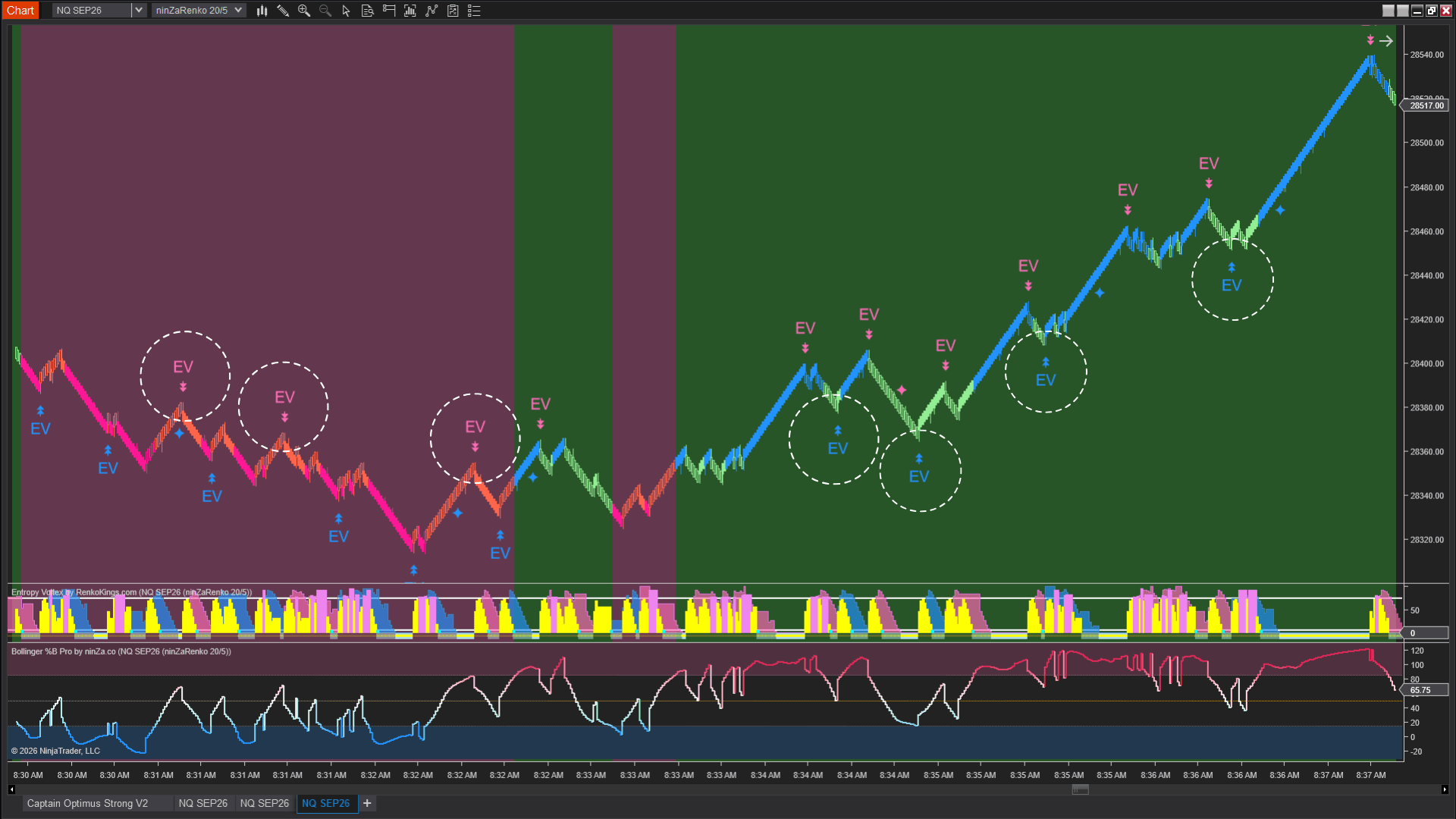
2 strategy paths
The first strategy combines trend, zone, signal, and momentum to identify entries at more favorable locations with layered confirmation.
One approach emphasizes broader confirmation and more entry opportunities.
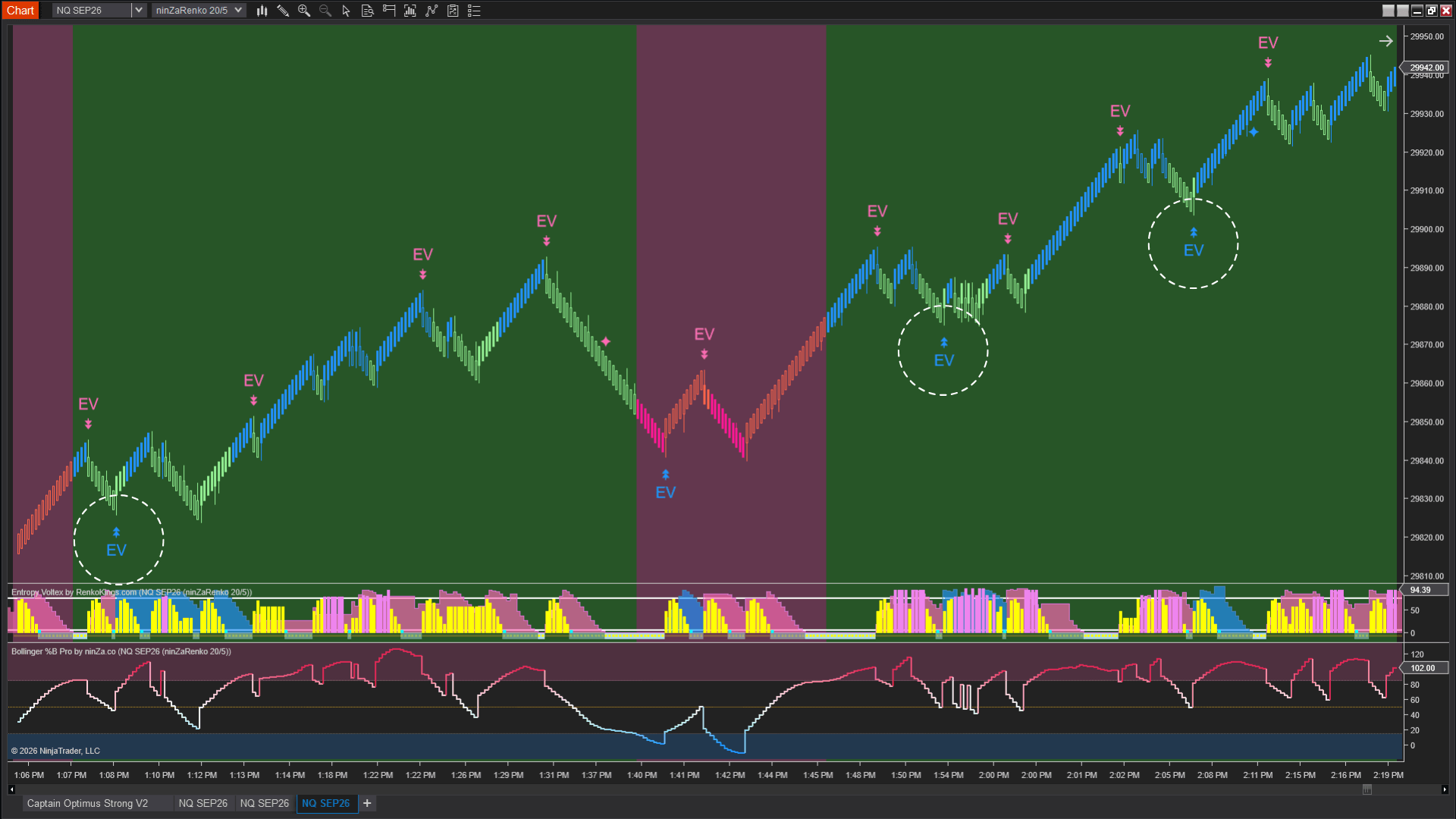
The second strategy focuses more directly on momentum. It is designed to prioritize trades only when buying or selling pressure becomes strong enough to support a more decisive move.
The other emphasizes fewer setups with greater reward potential.
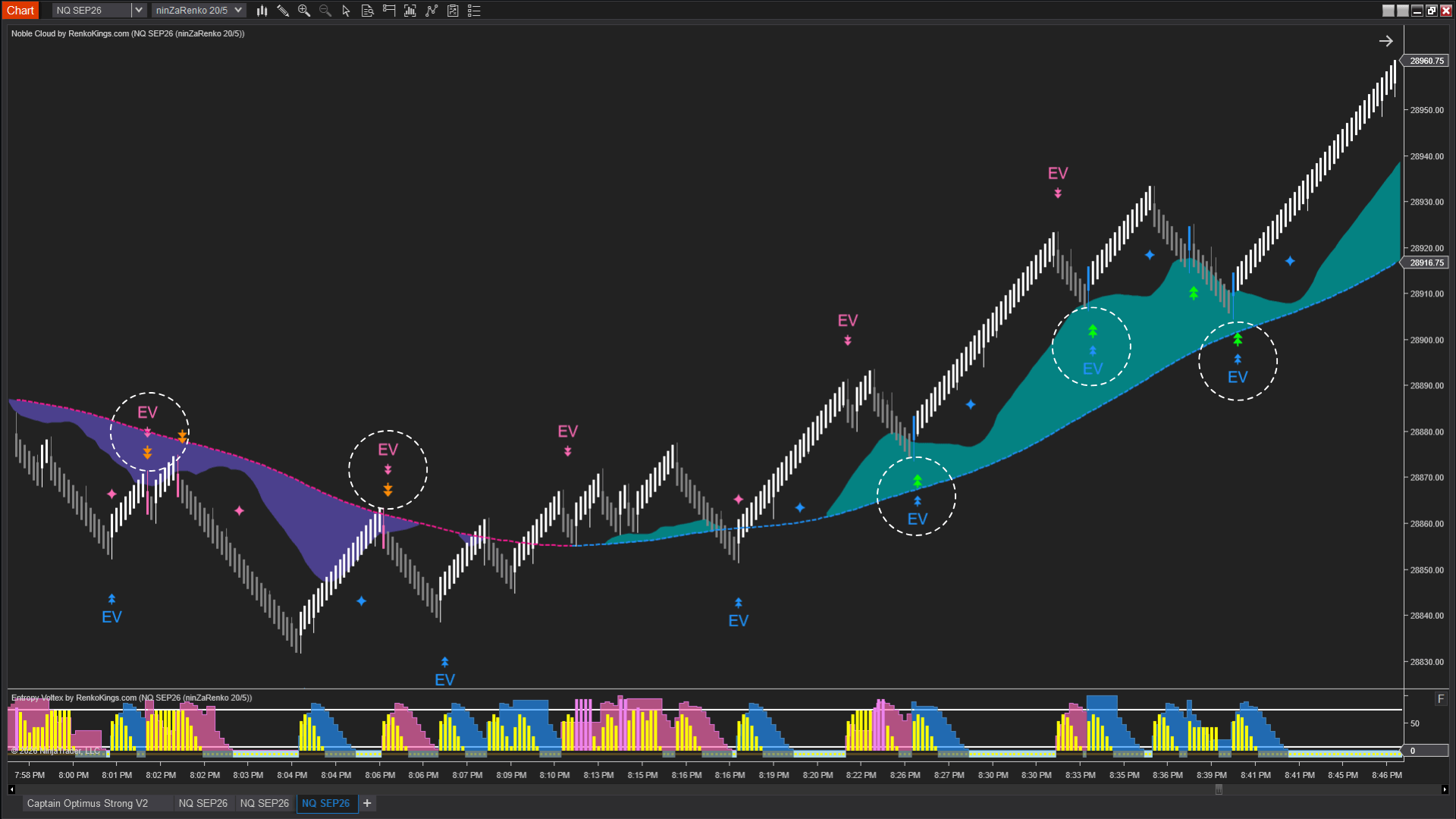
Strategy 1: Context-aligned scalping
This strategy is designed for scalpers who want momentum supported by broader market context.
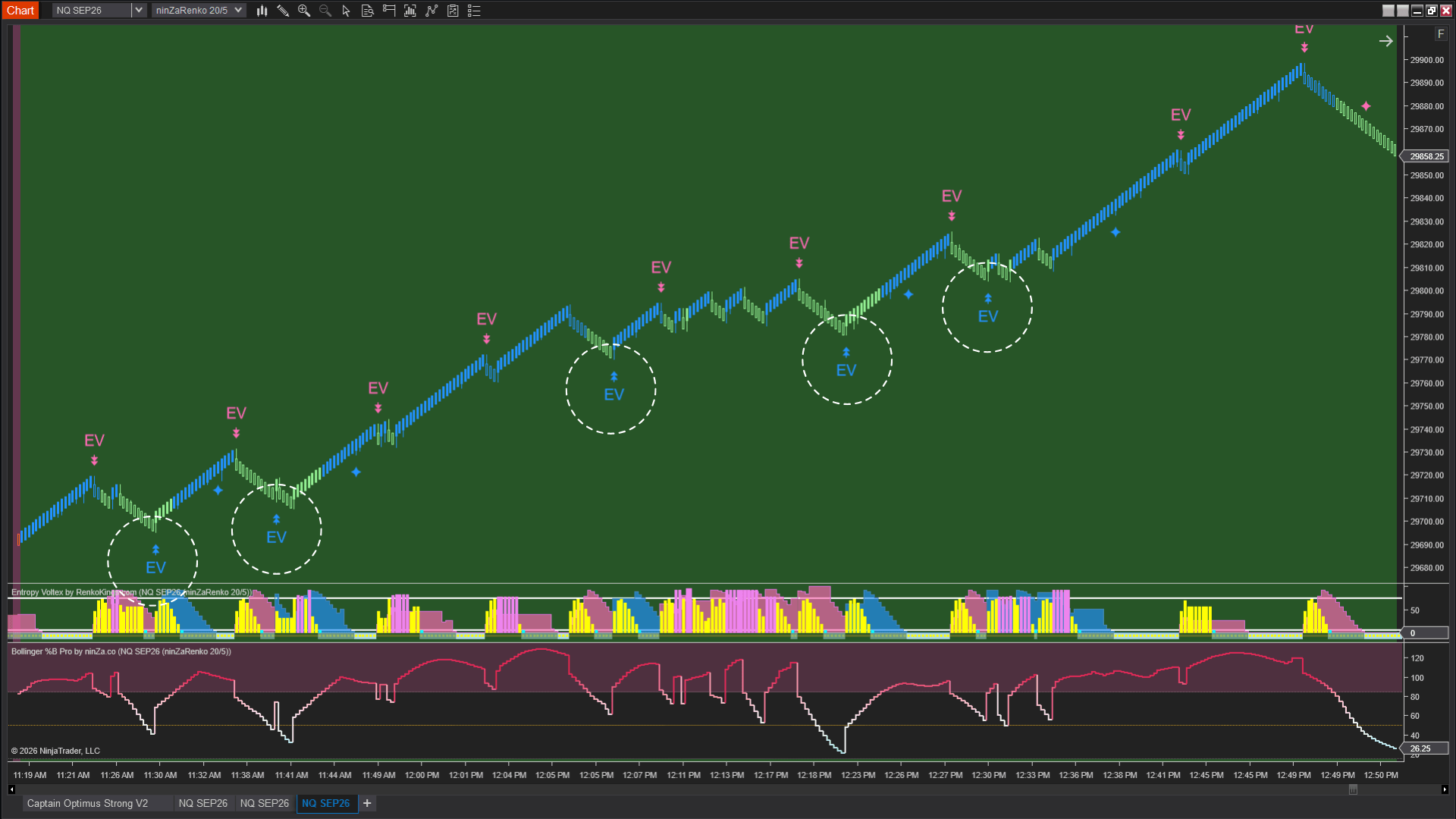
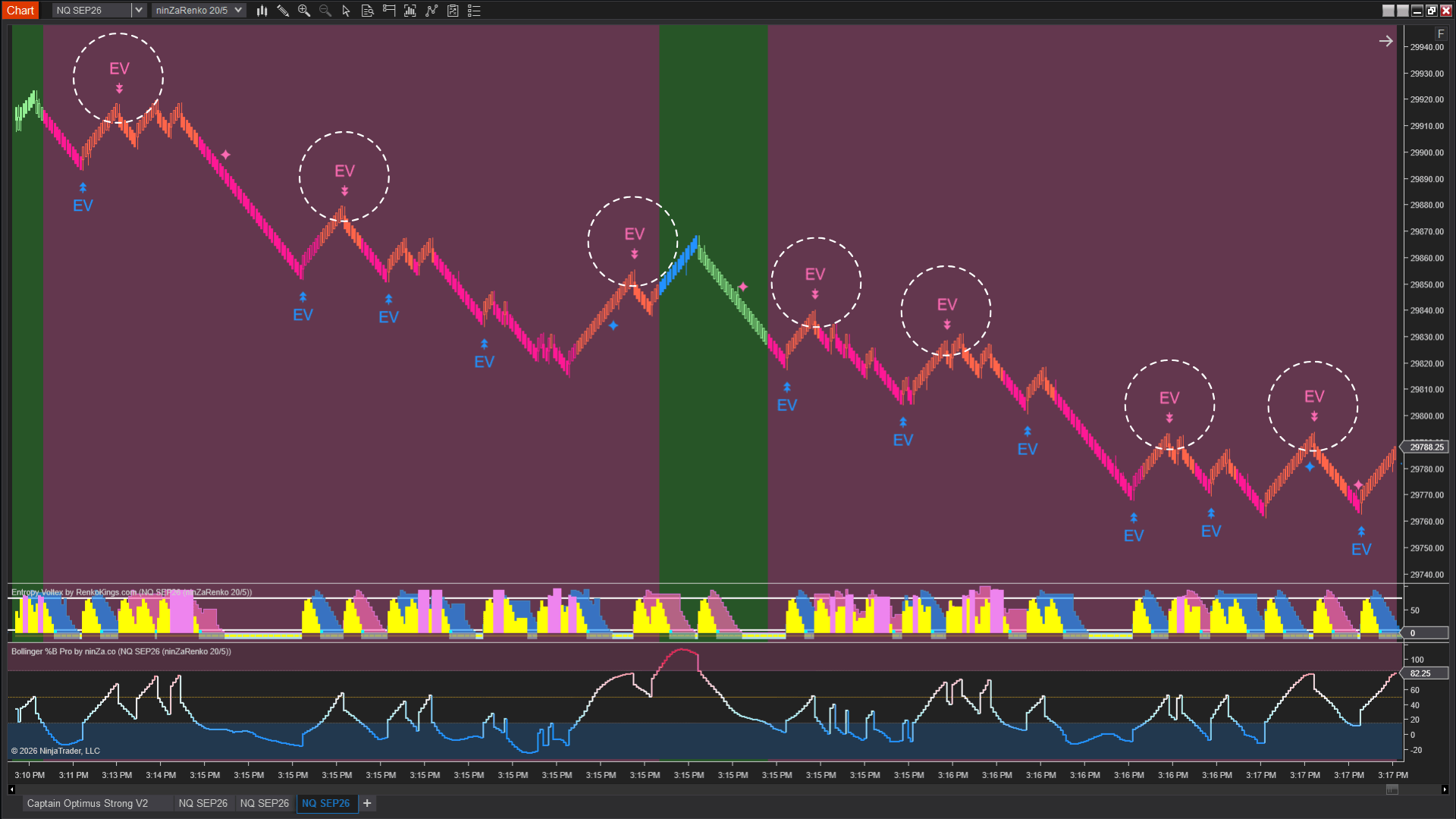
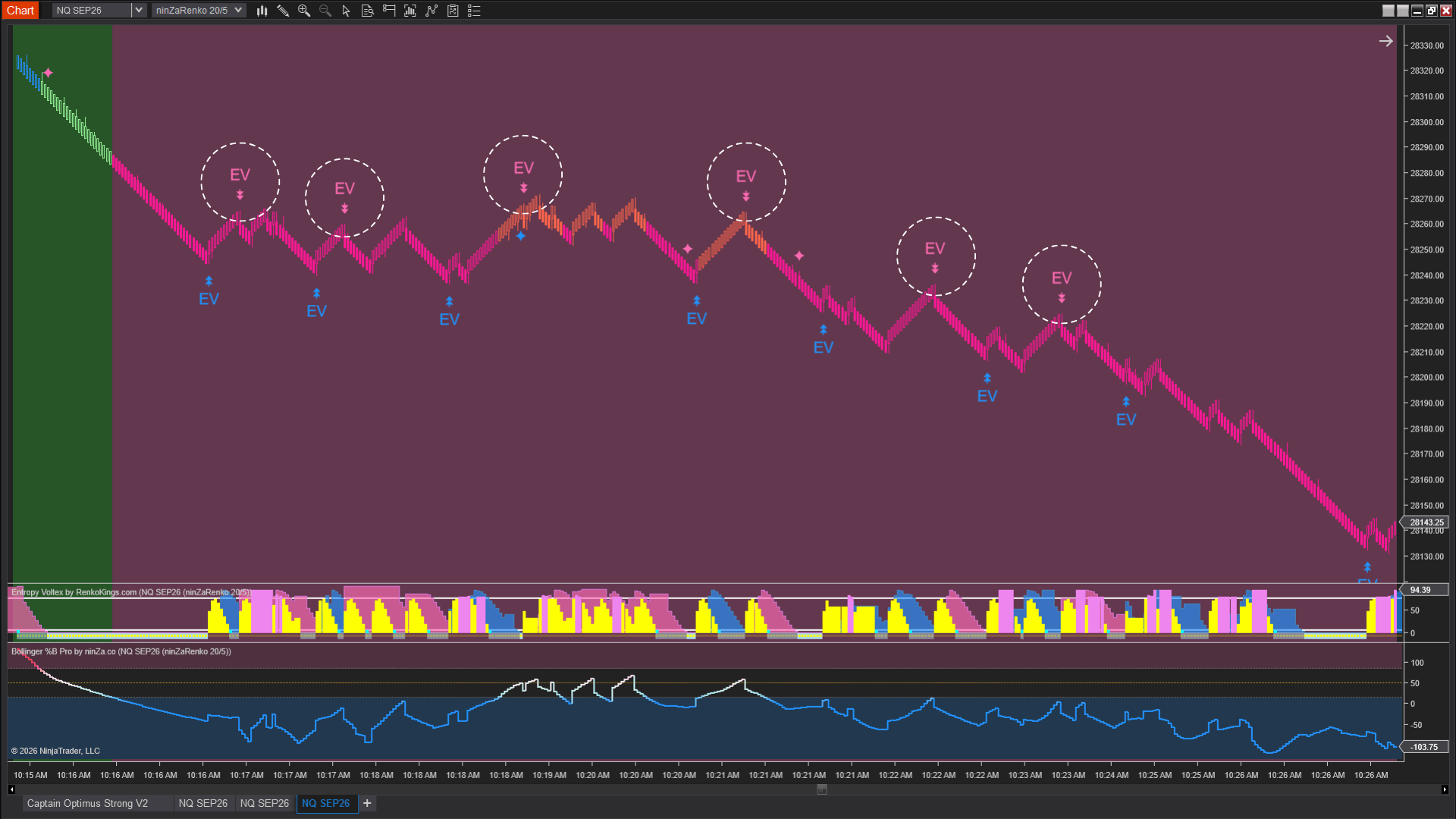
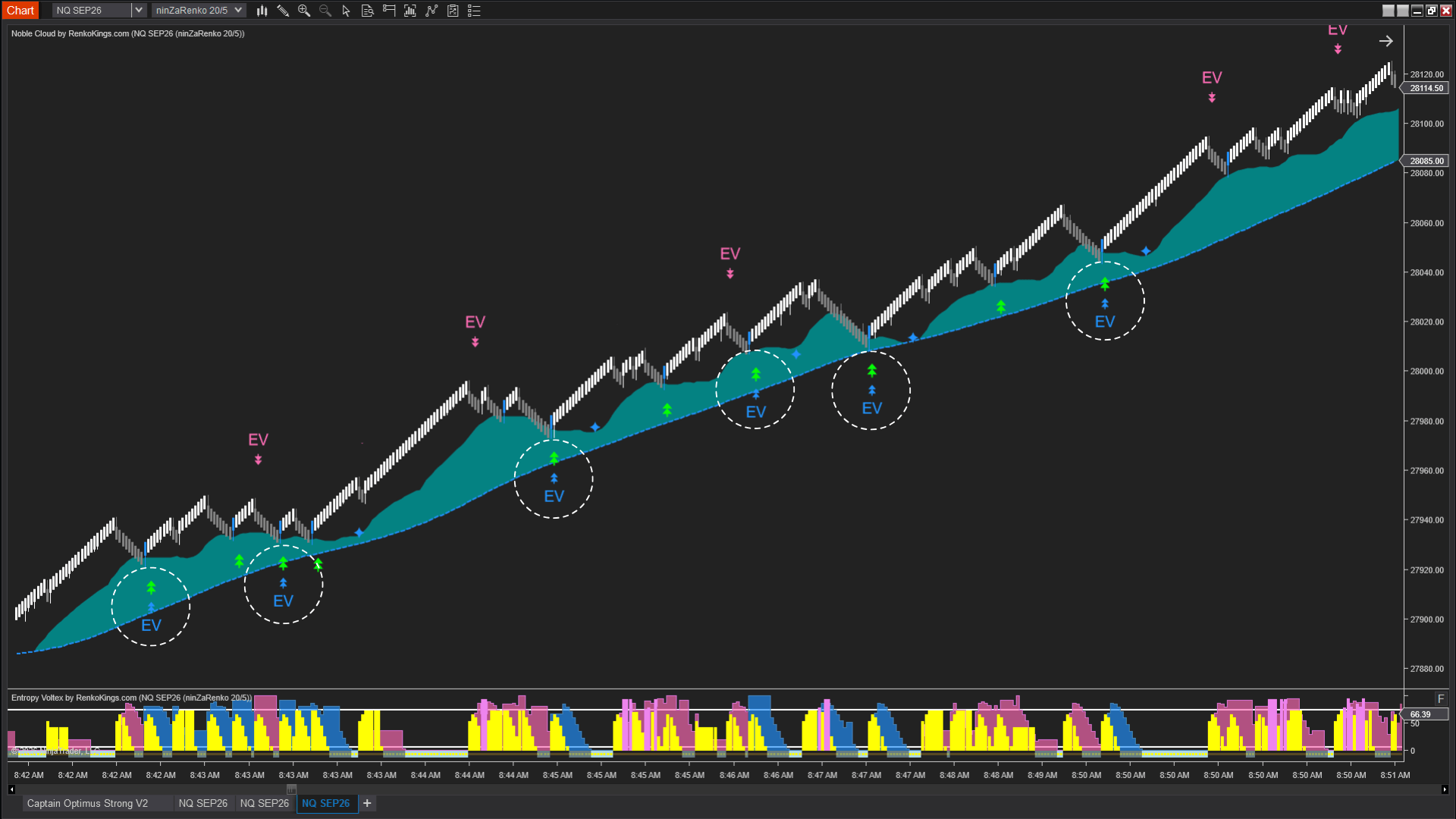
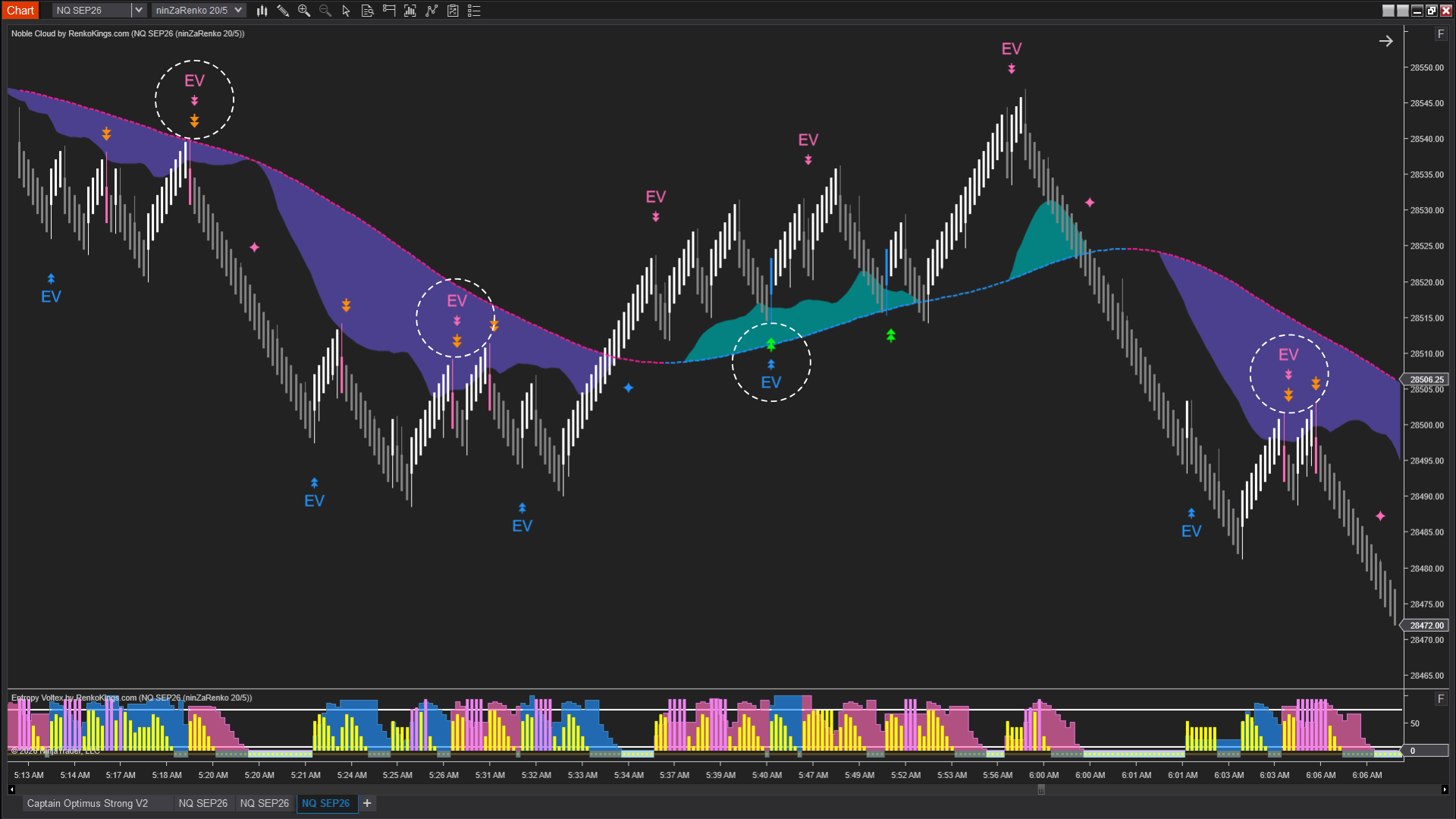
Entropy Voltex identifies a momentum-led entry signal.
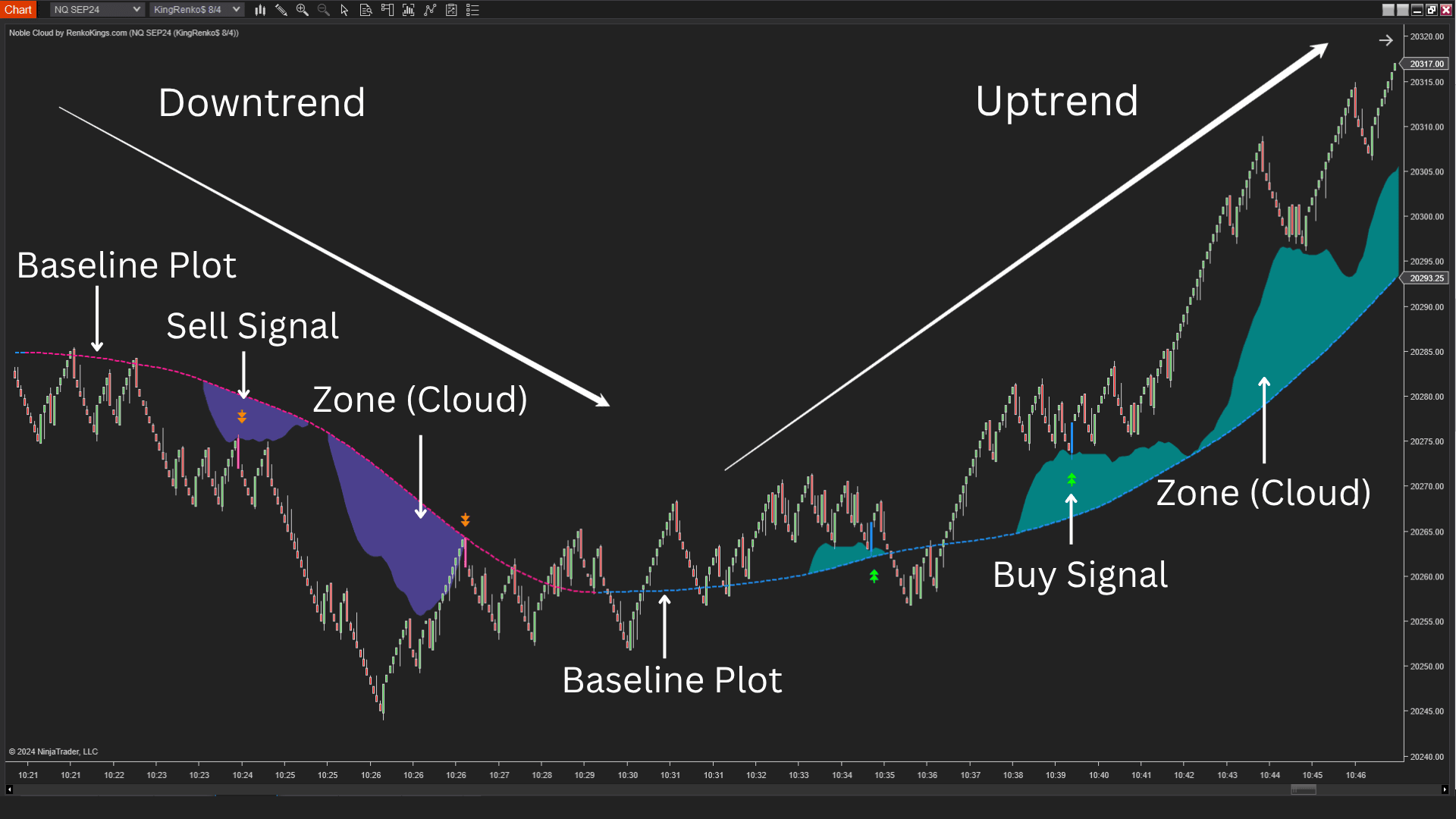
Noble Cloud organizes the surrounding conditions directly on the chart, helping the trader see whether the setup also aligns with:
When these conditions overlap, the trader can quickly see whether trend, location, signal, and momentum support the same trade direction.
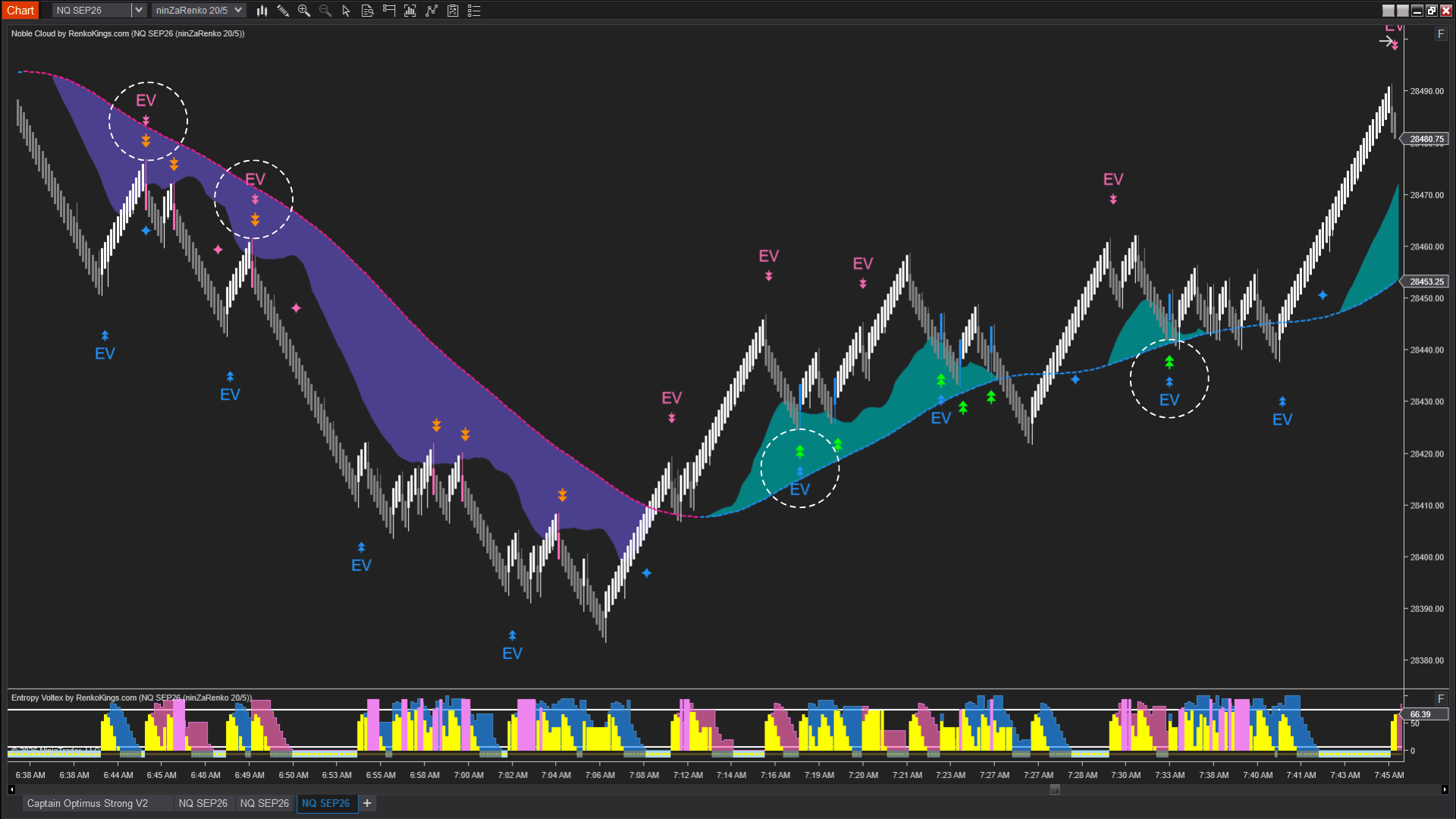

Scalpers rarely have enough time to analyze multiple chart elements one by one before every entry.
This strategy reduces that workload by bringing the main decision factors into one clear chart view. Instead of manually assembling the analysis, the trader can see the relevant context as the setup develops.
The analysis is already organized on the chart.
The trader can focus on the decision that matters most: the entry.
This approach is suited to scalpers who want more entry opportunities supported by clear, multi-layer confirmation.
Strategy 2: Momentum-led scalping
This strategy is designed for scalpers who want to trade more directly with directional momentum.
Momentum-led setup
Directional strength and resumption
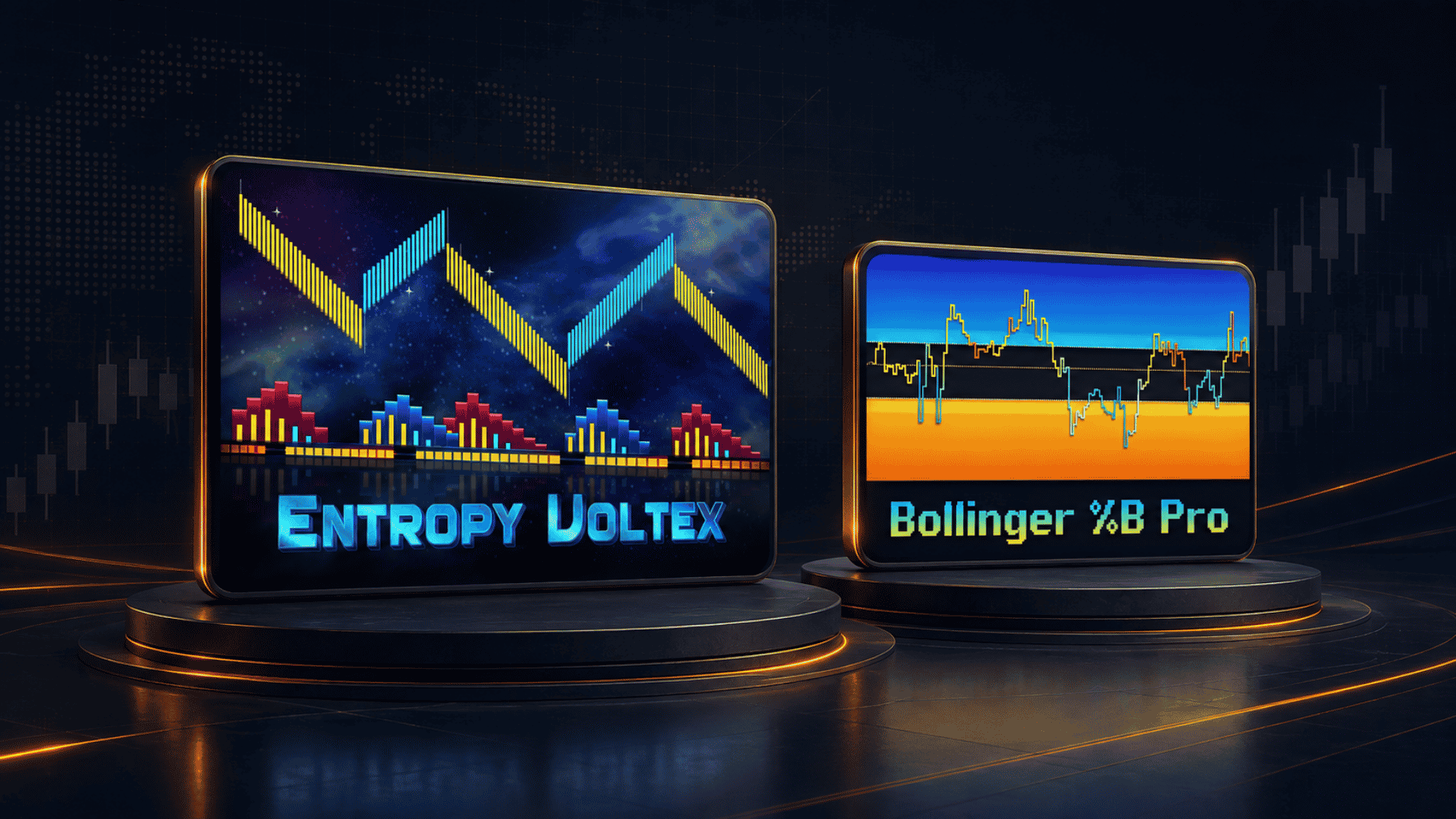
The logic is straightforward:
Entropy Voltex identifies the momentum transition.
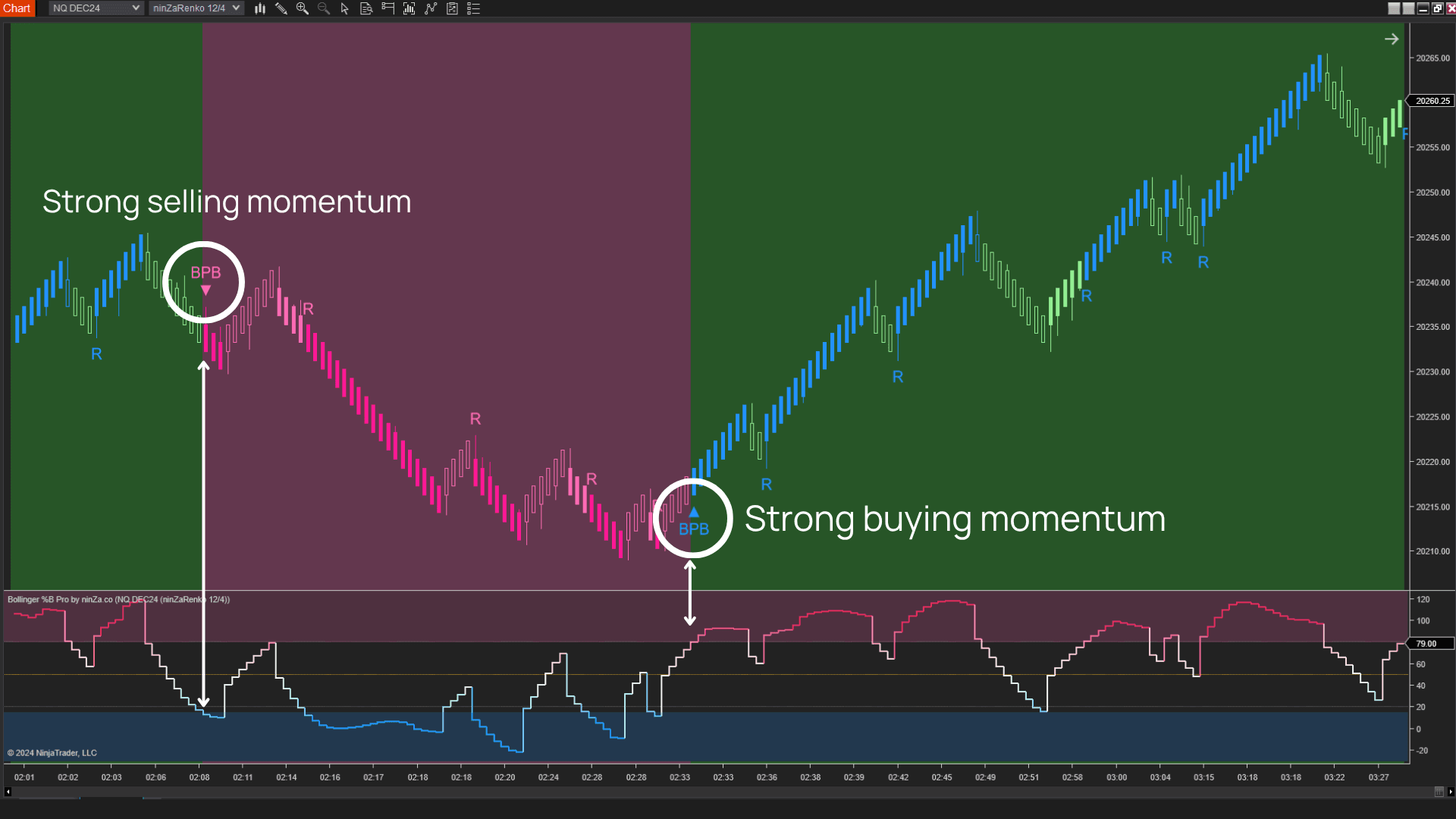
Bollinger %B Pro provides an additional view of whether buying or selling momentum is strengthening, resuming, or beginning to lose force.
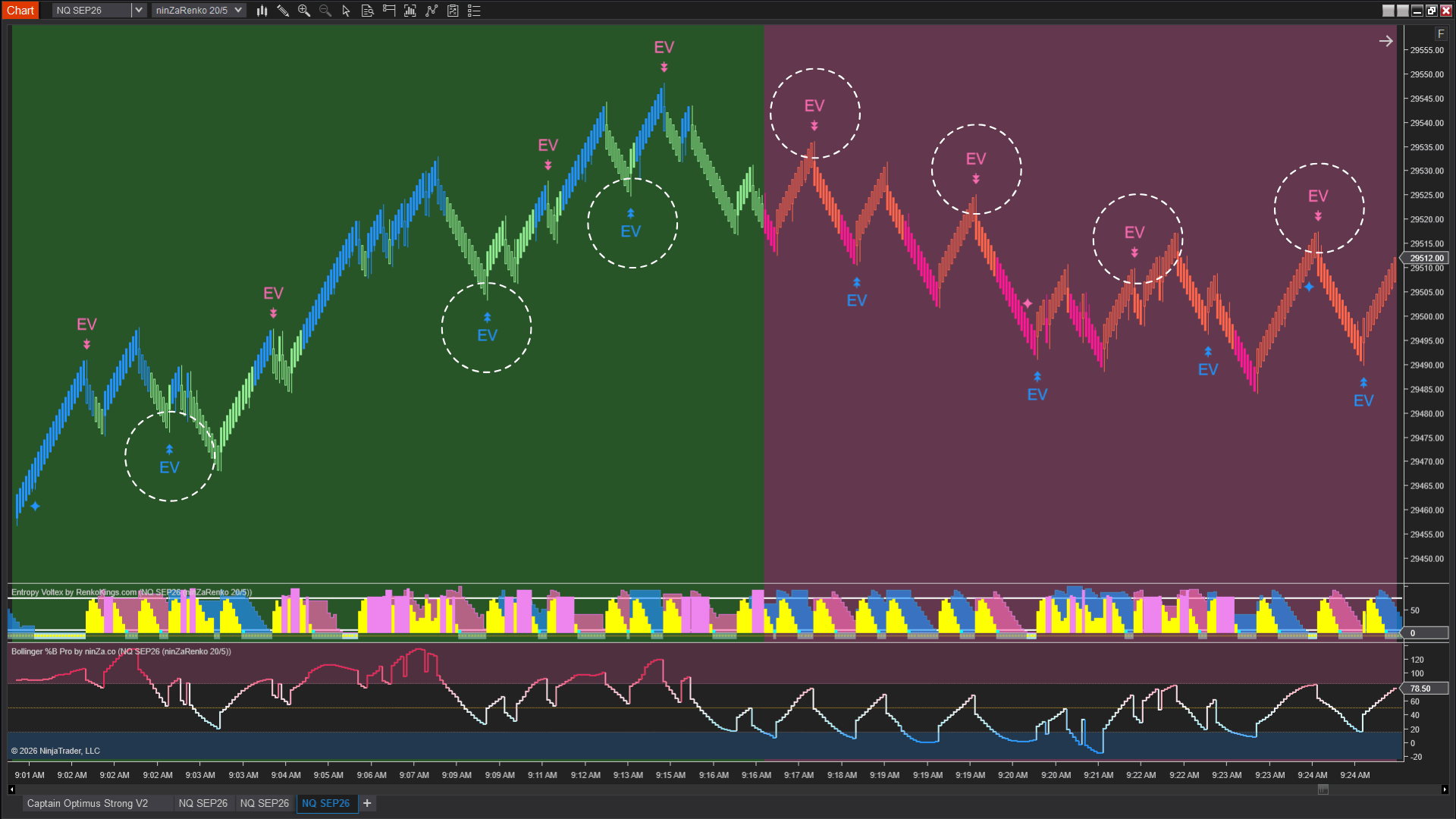
This strategy has been refined to place more emphasis on the reward potential of each setup.
It may produce fewer signals than Strategy 1. However, the setups it does identify are intended to take fuller advantage of strong directional momentum and the available expansion after entry.
The trade-off is clear:
Fewer setups. Greater emphasis on reward potential.
When the market provides enough room, 1 larger winning trade may offset more than 1 smaller loss.
This is a potential advantage, not a guaranteed outcome. Results still depend on market conditions, entry timing, risk parameters, and trade management.
The goal is not to trade every signal.
It is to prioritize setups supported by the strongest momentum.
Practical outcomes
Expansion Entry Scalping Solution is designed to improve the decision behind each entry, not simply add more signals to the chart.
Strategy 1 brings trend, zone, entry location, signal, and momentum into one defined chart view.
This gives scalpers access to multi-layer confirmation without requiring them to analyze every condition separately before each trade.
The result is less time spent assembling the setup and more attention available for entry, risk, and trade management.
The framework focuses on momentum as it begins to develop around the entry.
This helps traders identify opportunities near the beginning of a stronger move instead of acting after momentum has already weakened or the expansion is nearly complete.
The goal is not to predict the entire move. It is to recognize when the conditions for timely follow-through are beginning to form.
A strategy can be technically sound but difficult to execute if it requires too much analysis in too little time.
Expansion Entry Scalping Solution keeps the decision process focused and practical.
The trader does not need to monitor a long list of disconnected conditions. Each strategy has a clear purpose and a defined way to evaluate the entry.
The 2 strategies support different trading priorities.
Choose Strategy 1 when you want:
Choose Strategy 2 when you want:
Neither approach is automatically better.
The right choice depends on whether the trader wants to prioritize the number of qualified opportunities or the reward potential of each qualified setup.
A trade can be considered because trend, zone, signal, and momentum align.
Or it can be considered because directional momentum itself has become strong enough to justify the opportunity.
Either way, the entry is based on more than the appearance of a buy or sell signal.
The framework is not designed to keep the trader constantly active.
It supports passing on slow, choppy, or indecisive conditions and focusing on the moments when the market provides a clearer reason to participate.
Live trading application
In this video, we break down a momentum scalping approach that prioritizes confirmation and setup quality instead of trading every market move.
You’ll also see 10 consecutive winning trades from a live session, with each entry reviewed to explain why the setup was selected.
In this video, we explore how dual momentum confirmation helps scalpers wait for stronger entries instead of reacting to every market move.
You’ll also see 23 consecutive MNQ trades, showing how quickly price responds after entry and how the same setup can support both smaller scalping targets and larger reward objectives.
Let’s watch Live trading session #3 with the Expansion Entry Scalping Solution.
In this video, we put the Dual Momentum strategy to the test in live market conditions, showing how trades are executed and managed as the session unfolds.
Across 20 live trades, 15 ended in profit, giving a practical look at how the setup performs beyond theory – including how positions are handled when market conditions or unexpected issues arise.
Backtest
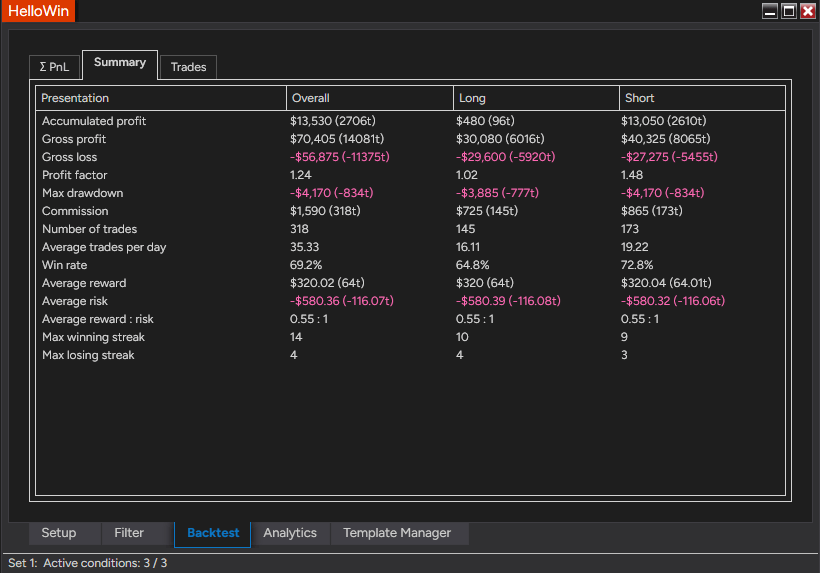
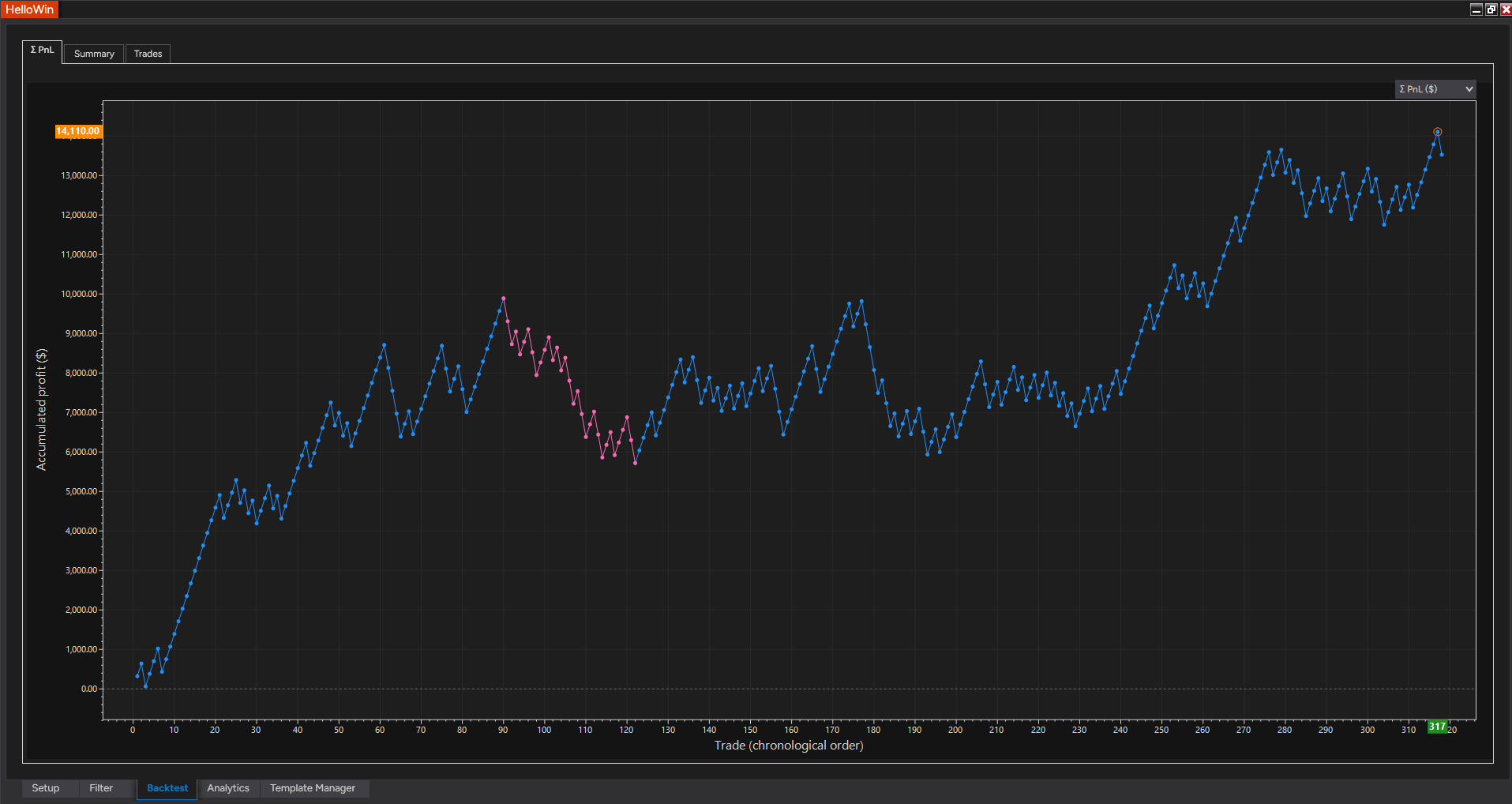
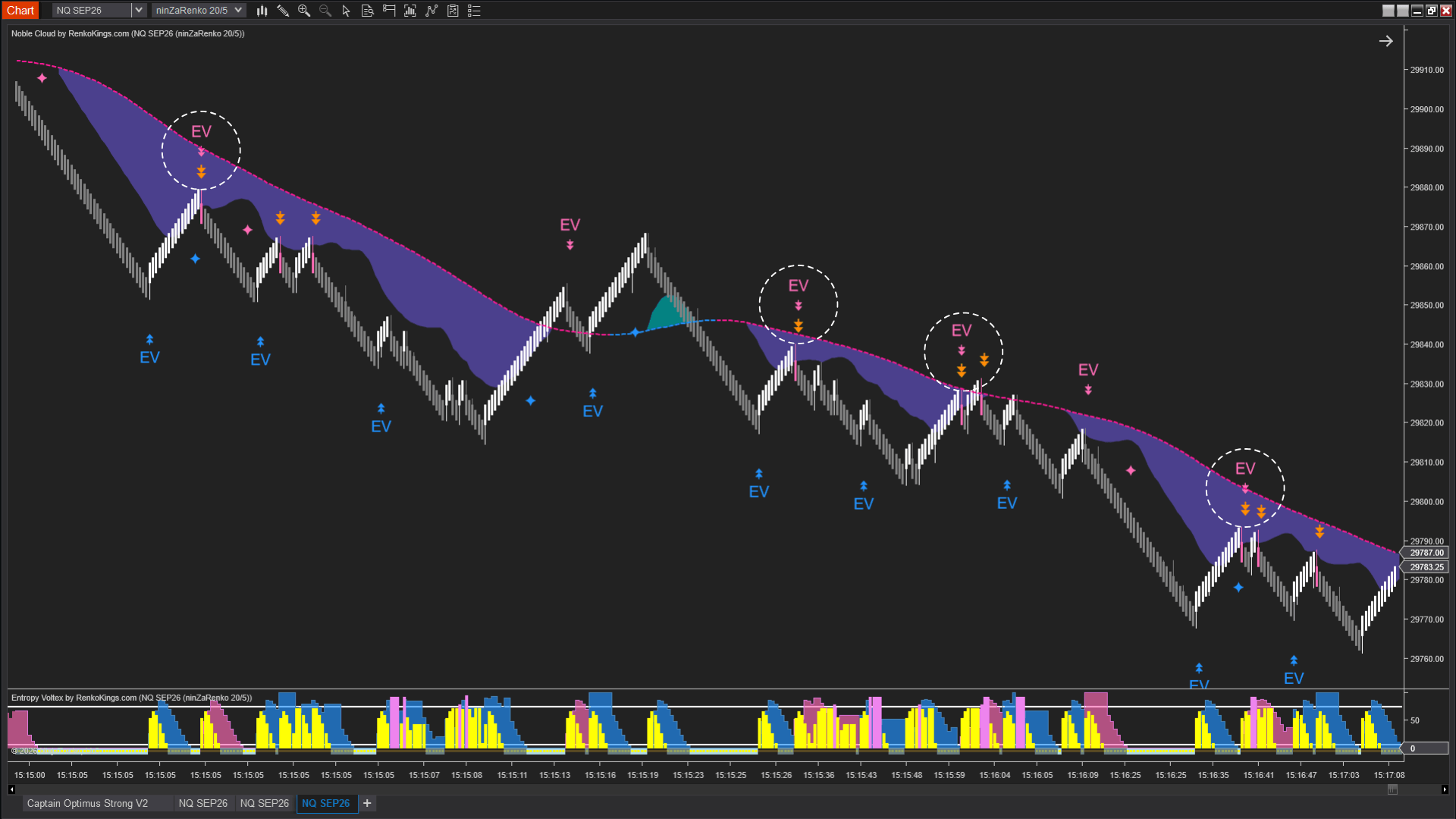
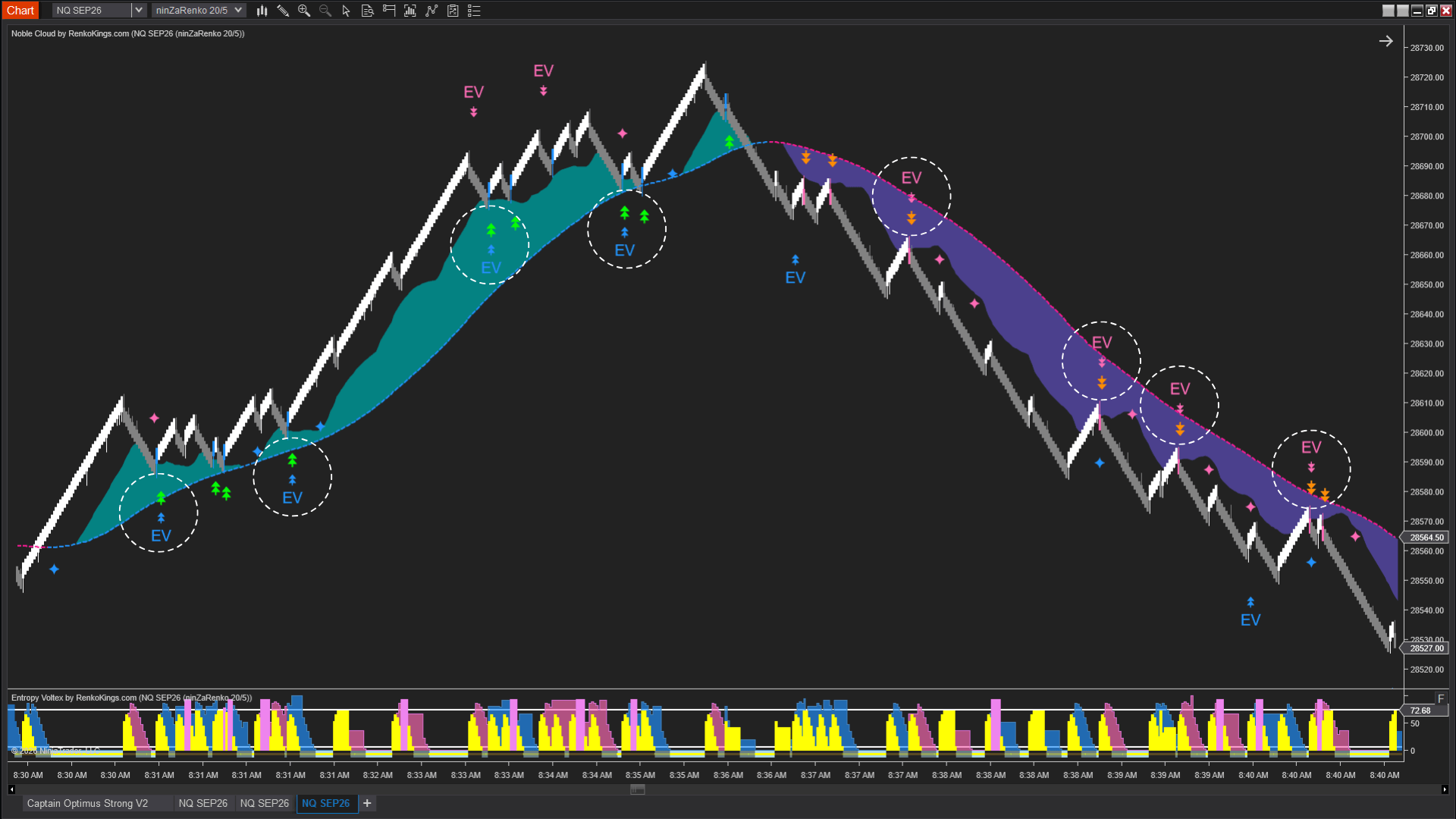
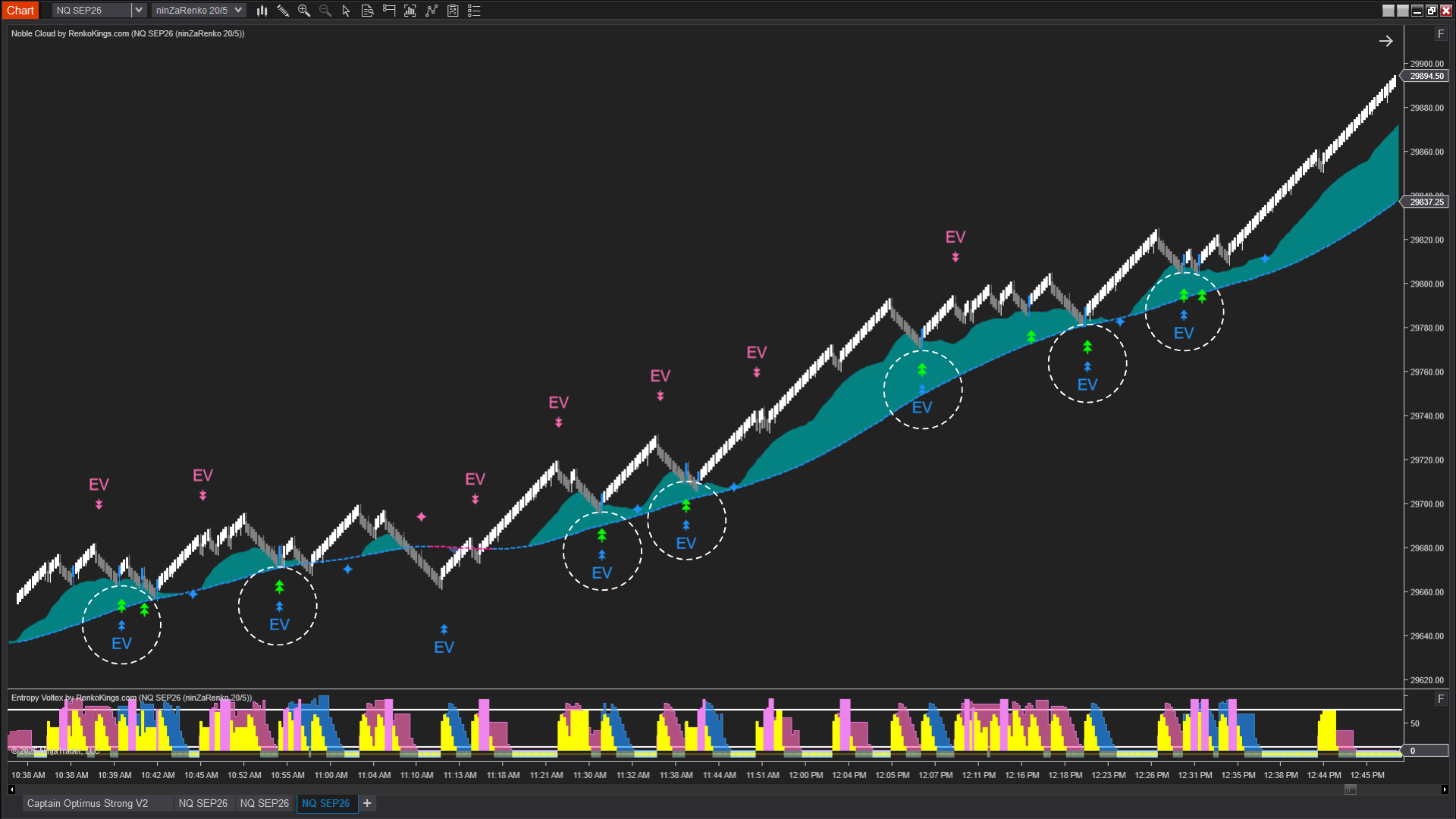
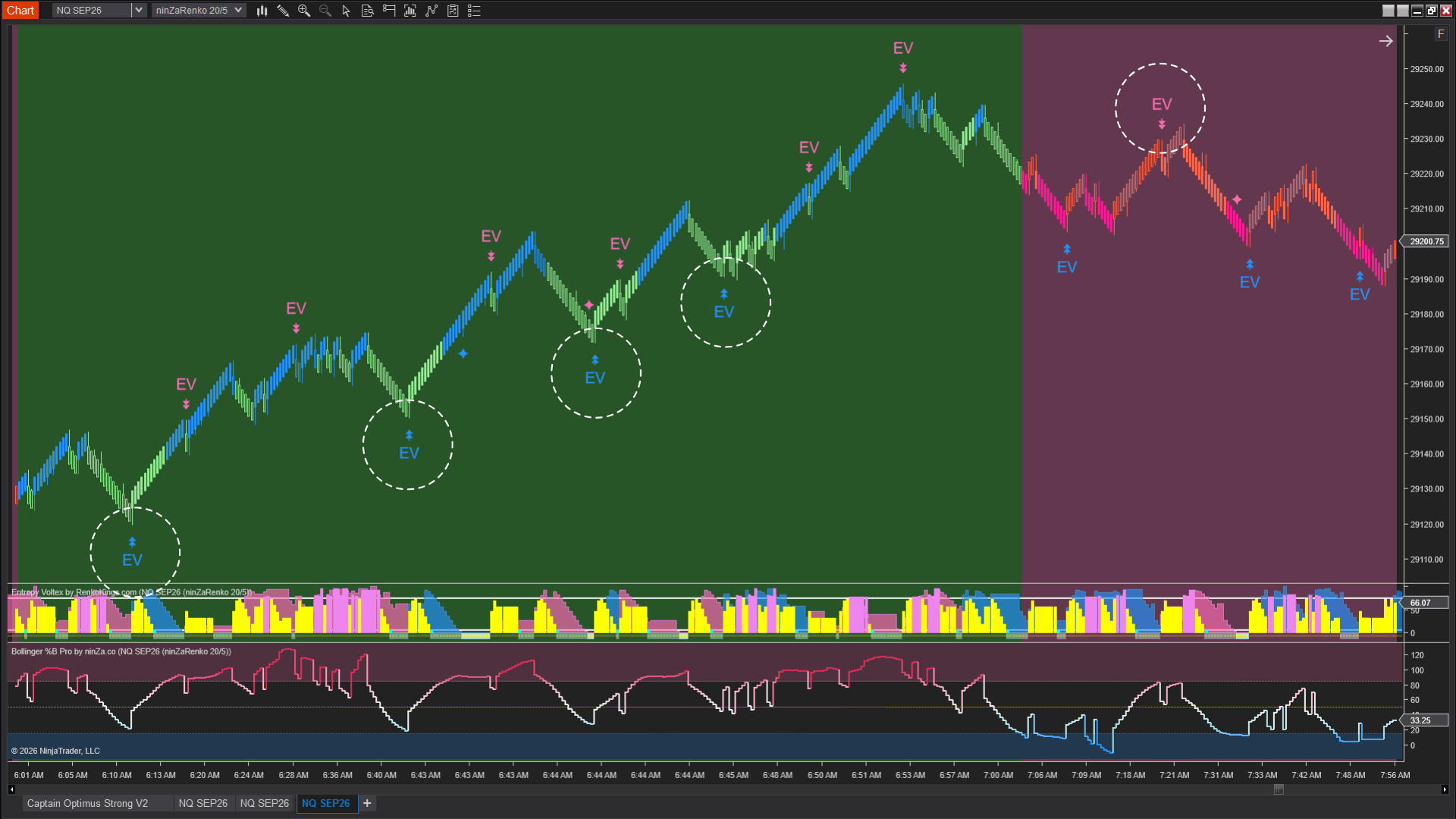
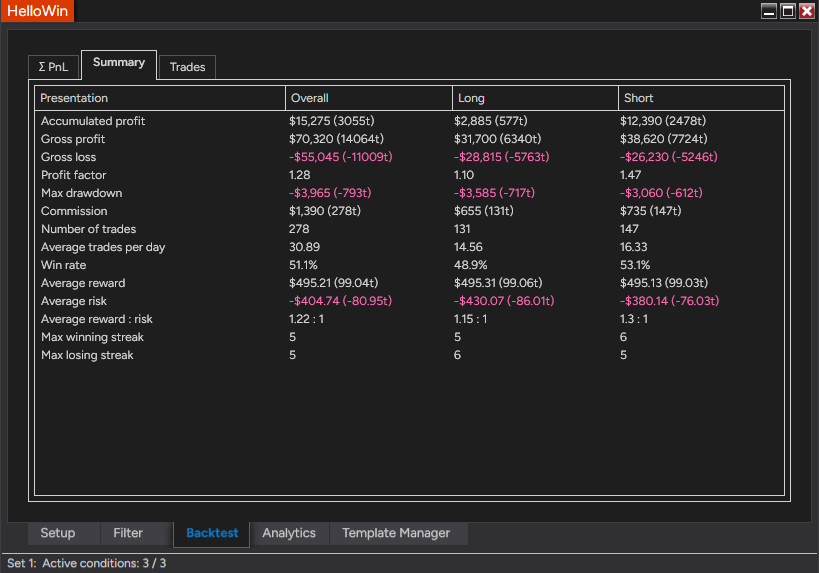
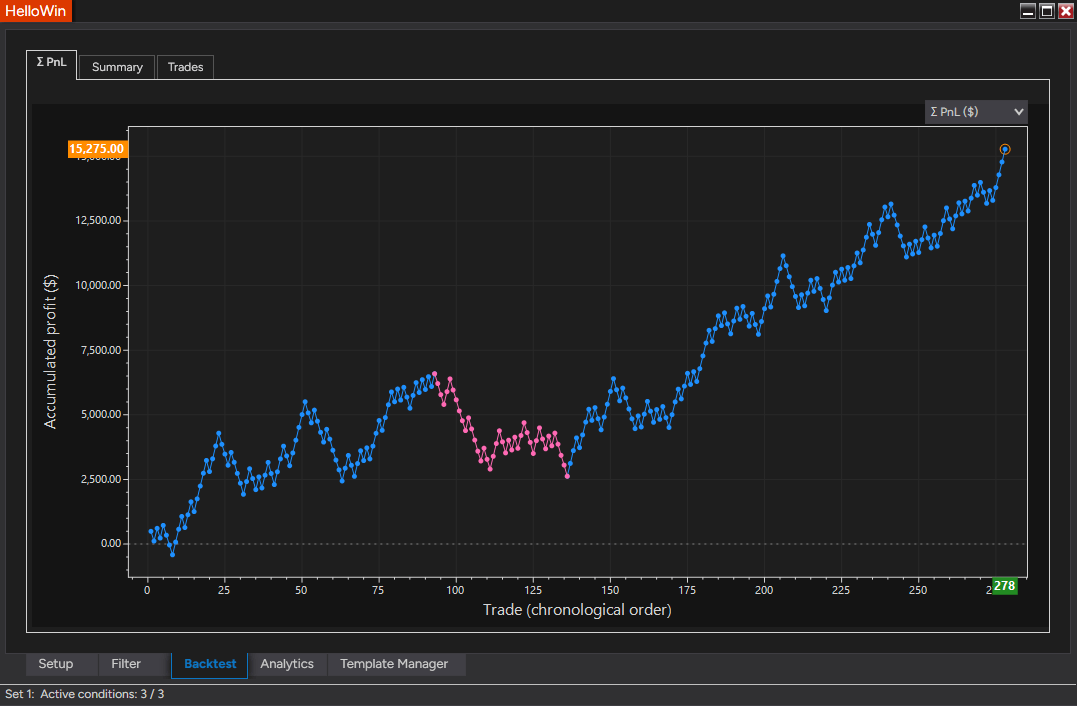
We backtested both setups over the same 2-week period to see how each approach behaved across repeated scalping opportunities.
Setup 1
Designed to provide more trade opportunities, Multi-element Confirmation recorded 318 trades, or about 35 trades per trading day.
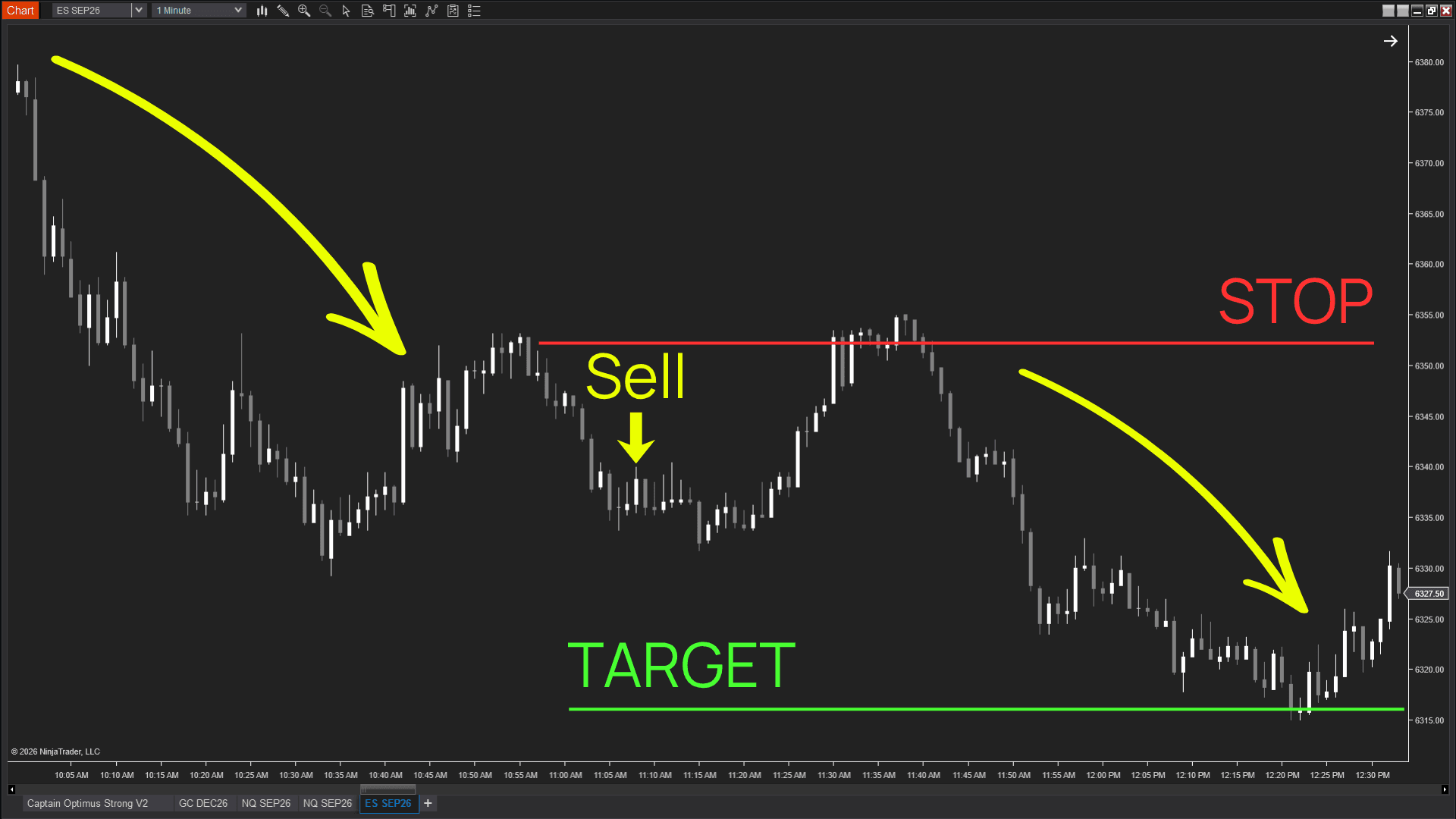
Much of the test period was a downtrend, with most of the stronger results coming from sell trades.
Setup 2
Dual Momentum places more emphasis on reward potential per setup while still providing enough opportunities for active scalping.
Over the same 2-week period, it recorded 278 trades, or about 31 trades per trading day. Most of the stronger results again came from sell trades during the downtrend.




Before you decide
No.
The solution is organized into 2 focused combinations:
Each combination serves a different type of entry decision.
Not necessarily.
Expansion Entry Scalping Solution is designed to support entry selection. You still control your instrument, chart type, execution, stop placement, risk, and trade management.
The purpose is to bring more structure to the entry decision, not replace your complete trading approach.
No strategy is equally suitable for every market phase.
The framework is designed to help traders recognize when momentum supports an entry and when greater selectivity may be more appropriate.
No.
Momentum can begin to build and still fail to continue. No indicator can guarantee that every signal will produce a successful trade.
The solution supports entry evaluation and selection. It does not replace risk management, trade management, or trader judgment.
You have up to 30 days to evaluate it within your own market conditions, chart setup, and trading process.
If it is not the right fit, you may request an exchange for another eligible product through Zuture Exchange.
Included with complete Solution access
Exclusive Renko perspective
Scalpers often use moving averages, ATR, swing highs, swing lows, and similar tools to identify market direction.
Micro Trend Dectector approaches short-term direction differently.
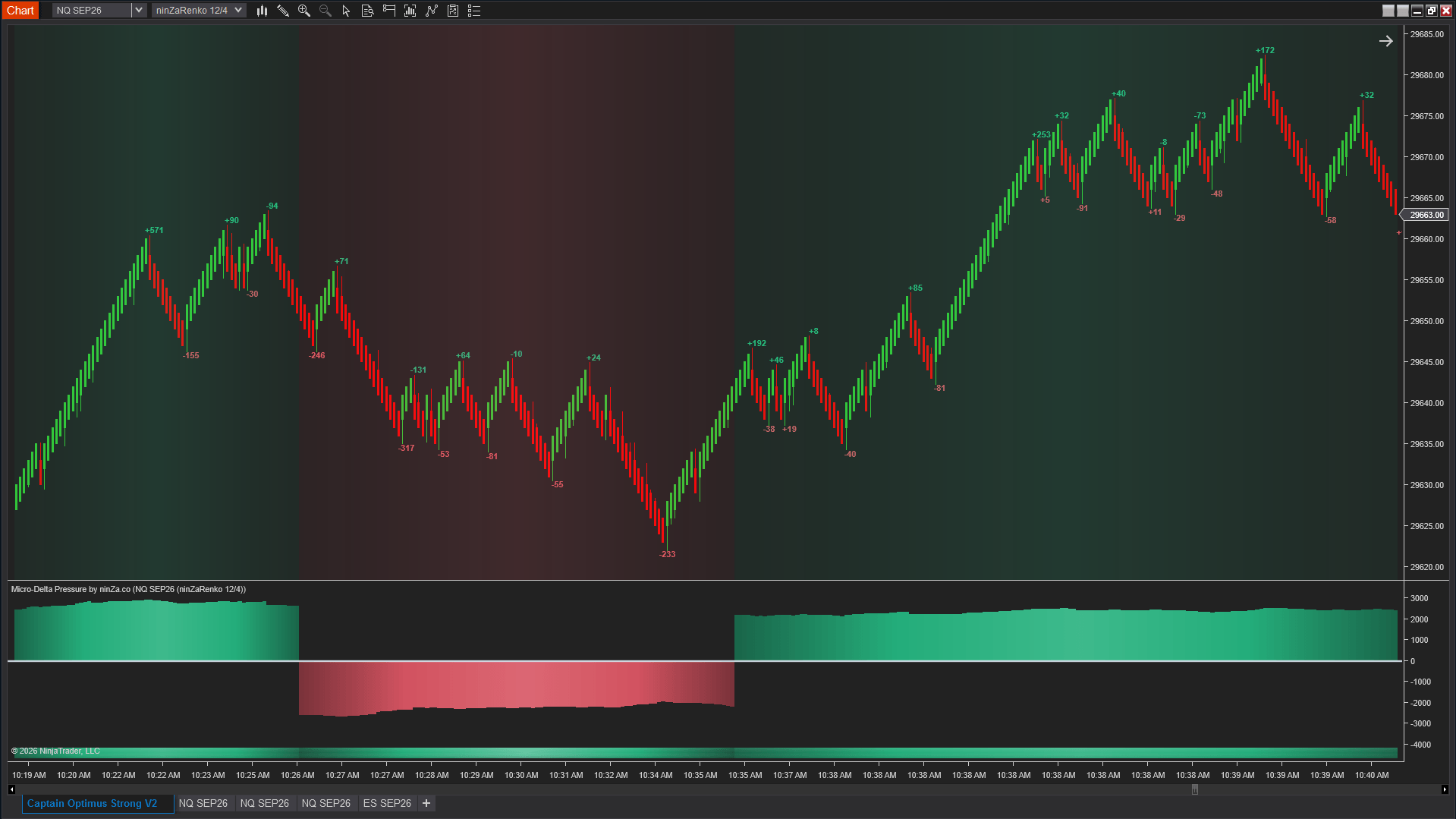
It tracks shifts in money flow to help Renko traders recognize changes in the micro trend.
This matters because a relatively small change in buying or selling flow can be enough to produce a sudden, decisive price move during a scalp.
When buying flow begins to strengthen, Micro Trend Dectector can show the development of an upward micro trend.
When buying flow weakens or selling flow becomes dominant, it can reveal a potential downward shift.
Money-flow perspective
Micro trend context
This gives the trader 2 useful perspectives:
01
The immediate micro trend around the entry
02
The broader money-flow context surrounding the setup
A trader can use this information to judge whether an entry is aligned with the current flow or moving against it.
Micro Trend Dectector is optional and is not required for either core strategy. It is included for Renko traders who want an additional layer of money-flow analysis around their entries.
It has not been released in the NINZA store and cannot be purchased separately.
It is included exclusively with Expansion Entry Scalping Solution.
A playbook built for practical use
The Expansion Entry Scalping Playbook explains how the indicators work together in real trading decisions.
It includes:
The trader is not left with several indicators and the question of how to combine them.
The playbook provides a clear process to follow.
Preview the playbook
Read the core principles and indicator logic behind the framework before unlocking the complete Expansion Entry Scalping Playbook.
Chapter 1
Indicators don’t make profitable traders. Consistent decisions do.
The purpose of Expansion Entry Scalping Solution isn’t to predict the market. It’s to improve the quality of your trading decisions.
Before discussing the indicators or trading checklist, one principle should be clear: No trading indicator can replace personal discipline.
Every trade carries risk, and every trading decision is subject to uncertainty. No indicator, trading system, or methodology can guarantee consistent winning outcomes under every market condition because markets are driven by probabilities, not certainties.
Expansion Entry Scalping Solution was created to solve a specific problem that many scalpers face:
Entering trades before the market has enough momentum to produce meaningful price expansion. This often results in trades where the market moves in the expected direction but fails to deliver sufficient follow-through.
At the same time, many traders struggle with information overload – trying to evaluate too many factors at once – which leads to hesitation, inconsistent execution, or emotionally driven decisions.
Rather than generating more signals, this approach helps you focus on a small number of objective conditions that matter most. The goal is to help you make clearer, more consistent decisions – not to replace your judgment, discipline, or risk management.
As you work through the rest of this guide, keep these 3 ideas in mind.
Chapter 2
This chapter answers a fundamental question: Why were these 3 indicators selected, and why does removing any one of them weaken the entire approach?
Before looking at each indicator individually, let’s start with a more important question:
Why do so many scalpers consistently lose money even when they correctly identify the market direction?
The answer is that direction alone is not enough.
Correct market direction is only 1 of 3 conditions required for a high-quality trade. The other 2 are the quality of the price movement at the moment of entry and the strength of the momentum driving that move.
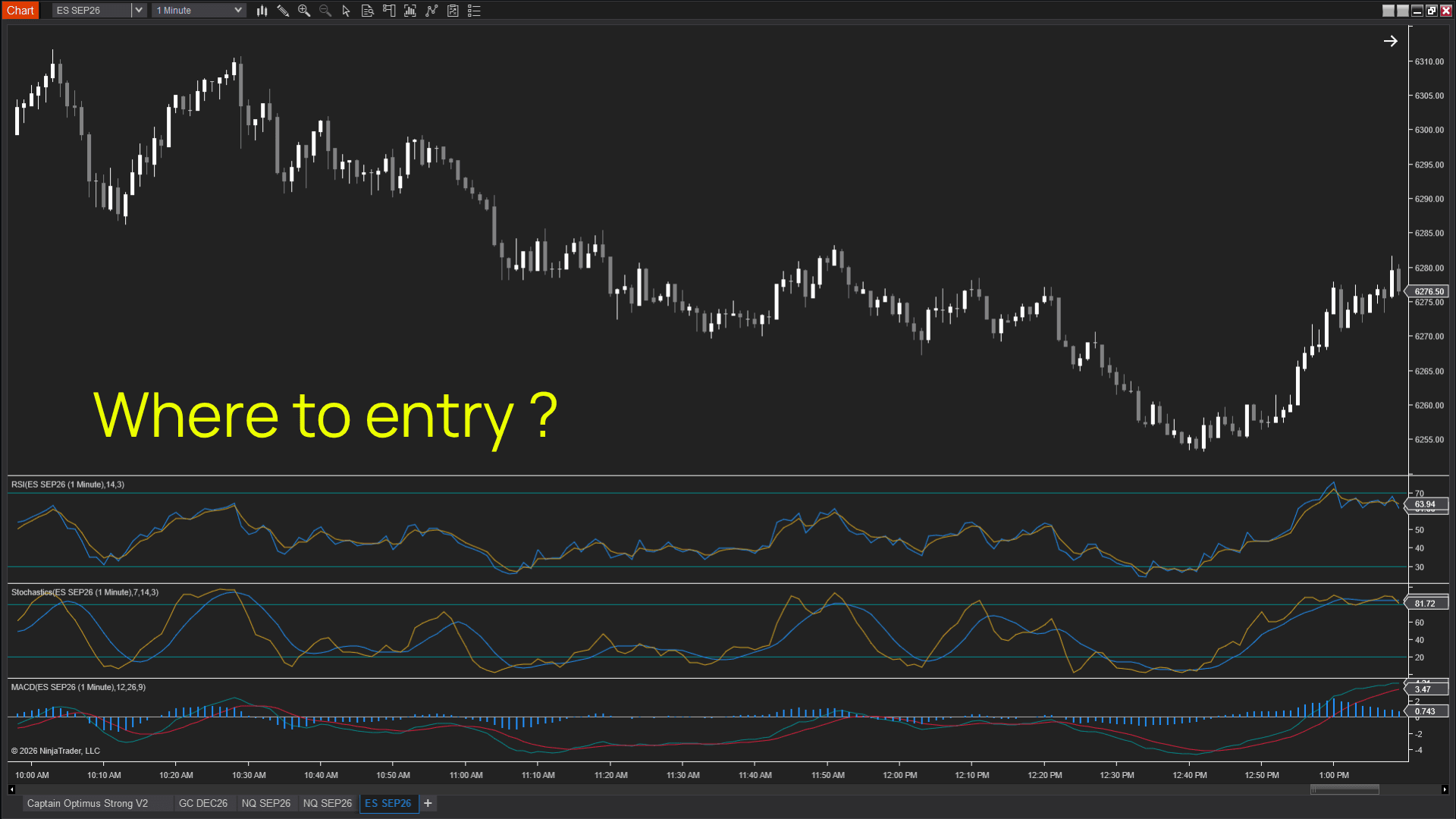
Most traditional indicator combinations – such as moving averages, RSI, MACD, and Stochastic – tend to measure different variations of the same thing. Although they use different calculations, they are all trying to answer essentially the same question:
“Where is the market likely to move next?”
As a result, a chart filled with multiple indicators confirming the same direction can still produce poor entries. They may agree on the trend, yet none of them answers 2 questions that matter just as much:
Expansion Entry Scalping Solution was designed to fill this gap by separating the trading decision into 3 independent dimensions, with each indicator measuring a different aspect of the market rather than repeating the same information.
Each indicator is responsible for answering 1 critical question.
| Dimension | Indicator | Question it answers |
|---|---|---|
| Direction | Noble Cloud | Which direction should I trade, and where should I look for entries? |
| Movement quality | Entropy Voltex | Is the current price movement reliable, or is it just noise? |
| Momentum | Bollinger %B Pro | Is there enough momentum for the move to continue? |
This is one of the most common reasons traders experience the frustrating situation of getting the direction right, but seeing the trade go nowhere.
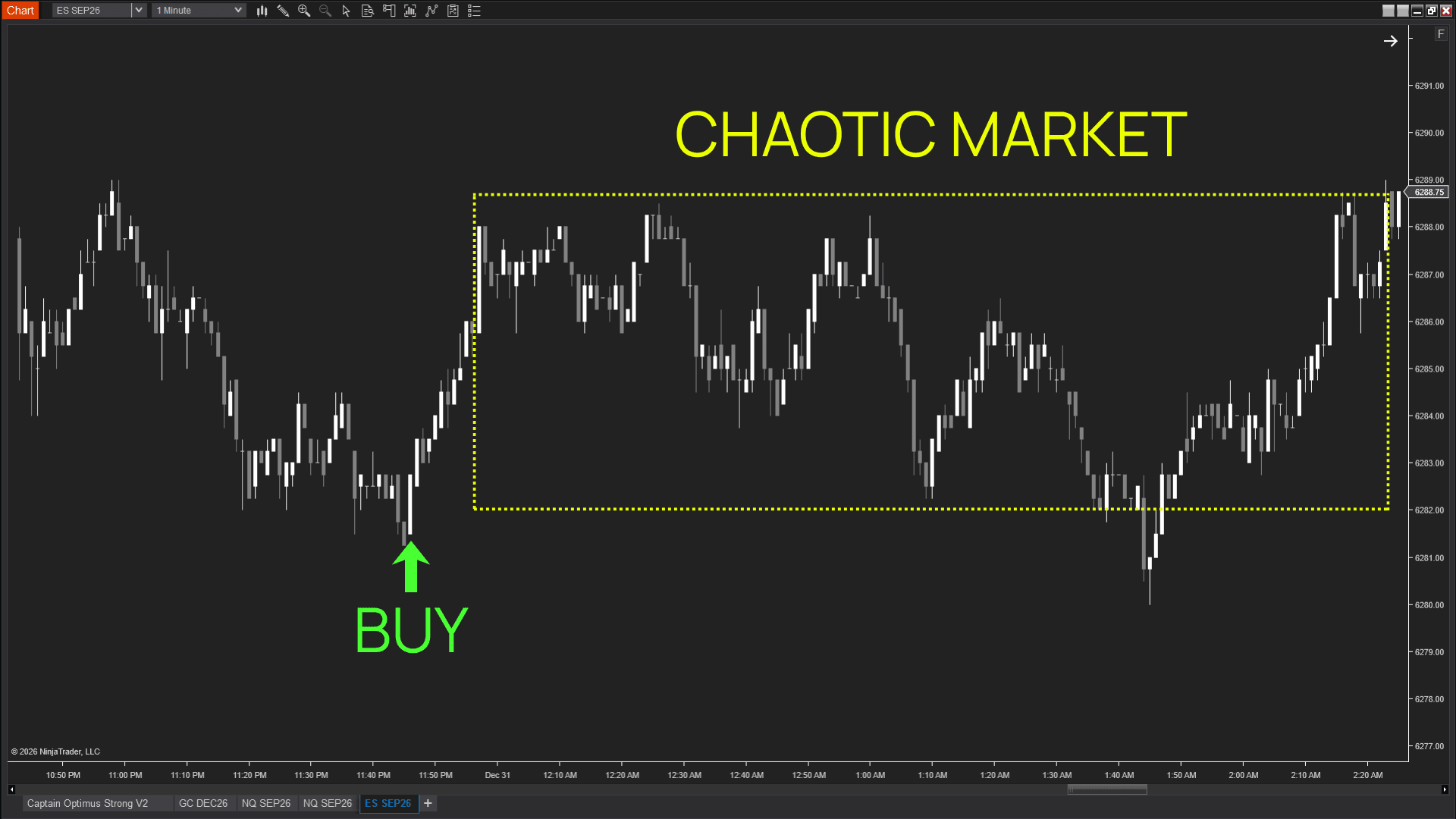
When the market lacks structure and price behavior becomes dominated by noise, even a correct directional bias offers little advantage. Without a stable market environment, price often fails to generate the follow-through needed for a successful trade.
A well-structured market doesn’t automatically lead to profitable trades.
Even under favorable market conditions, weak momentum can prevent price from reaching your target. Instead, the move may lose strength, stall, or transition back into a noisy environment before the trade has enough time to develop.
Strong momentum alone doesn’t necessarily signal the beginning of a new trend.
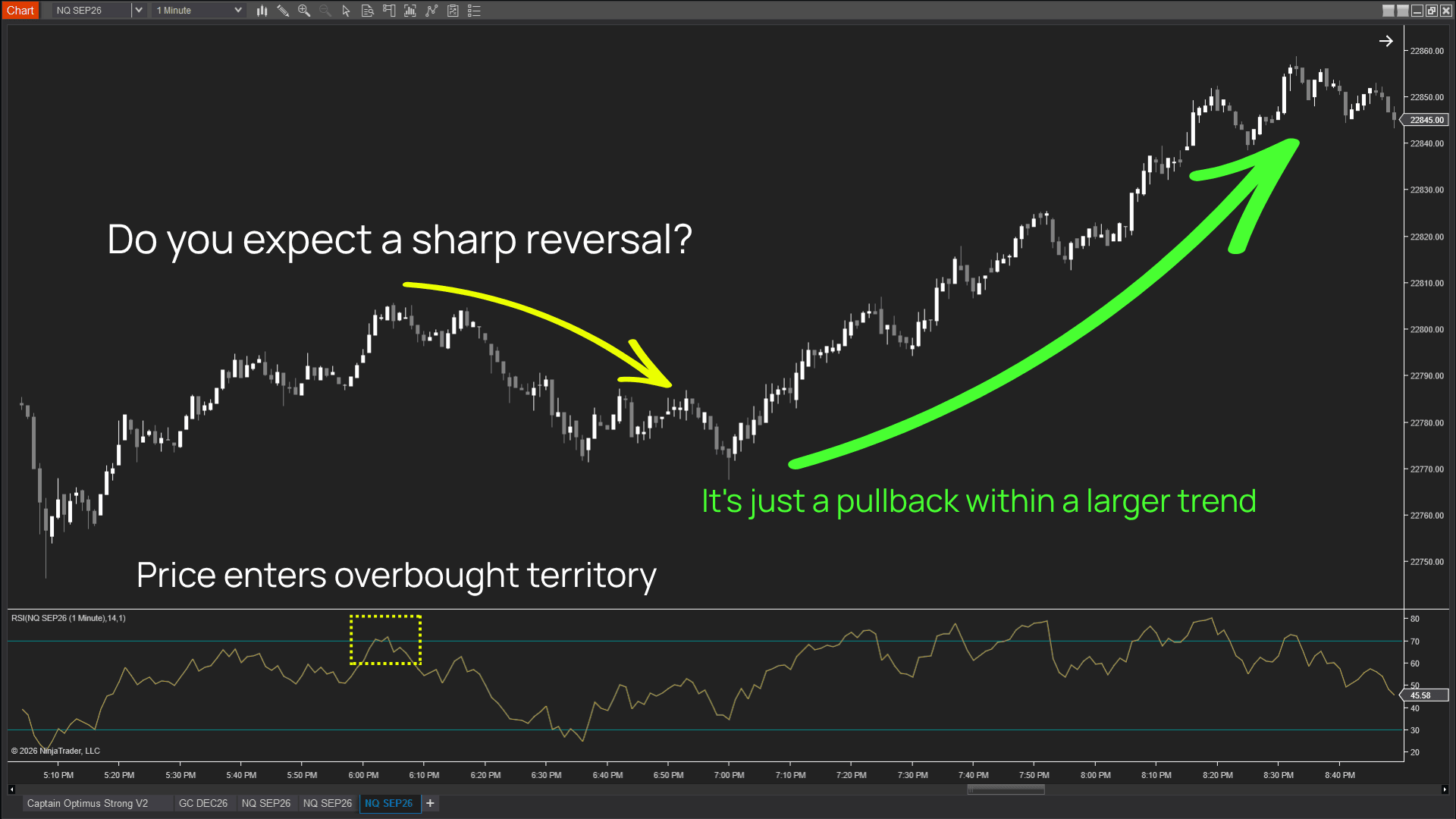
A common mistake among traders is relying solely on momentum indicators such as RSI or MACD. A strong momentum move against the dominant market direction is often nothing more than a sharp retracement rather than a genuine trend reversal, increasing the risk of trading against the prevailing trend.
This explains why many scalping strategies appear convincing in theory but become inconsistent in live markets. The problem isn’t a lack of trading signals – it’s a lack of independent confirmation.
Each indicator may perform well on its own, but without validating different aspects of the market, the overall decision remains incomplete.
This principle also aligns with the study by Barber and Odean involving 66,465 brokerage accounts, which found that the most active traders significantly underperformed the broader market. More trades did not lead to better results. Better trade selection did.
Most trend-following tools, such as a single Moving Average or EMA, represent trend with a single line. While this works well as a directional filter, it provides little information about where the market is actually likely to react.
Markets rarely respond to an exact price level. Instead, they tend to react within price zones where buying and selling activity has previously reached a temporary balance. This is why Noble Cloud is built around a cloud rather than a single line.
The cloud serves 2 purposes at the same time:
Price above the cloud favors long opportunities. Price below the cloud favors short opportunities. This is the most visible and straightforward function of Noble Cloud.
The cloud also represents an area where the market has previously established agreement around value.
In general, a thicker cloud suggests that price spent more time accepting that region in the recent past, creating stronger price memory. When price revisits the cloud, it is therefore more likely to react – either by finding support or encountering resistance – than at an arbitrary price level with little historical significance.
This is also why the pullback step in the trading checklist is just as important as identifying the trend itself.
Entering immediately after confirming the trend often means chasing price instead of waiting for the market to return to an area where buyers and sellers have previously shown meaningful agreement.
By waiting for a pullback into the cloud, you are using Noble Cloud as it was intended: not simply as a trend indicator, but as a framework for identifying higher-quality entry locations.
Among the 3 indicators, Entropy Voltex is the easiest to misunderstand. At first glance, it may appear to be another momentum indicator. In reality, it answers a completely different question.
Momentum asks how strongly price is moving. Entropy asks how organized that movement is.
This distinction is fundamental.
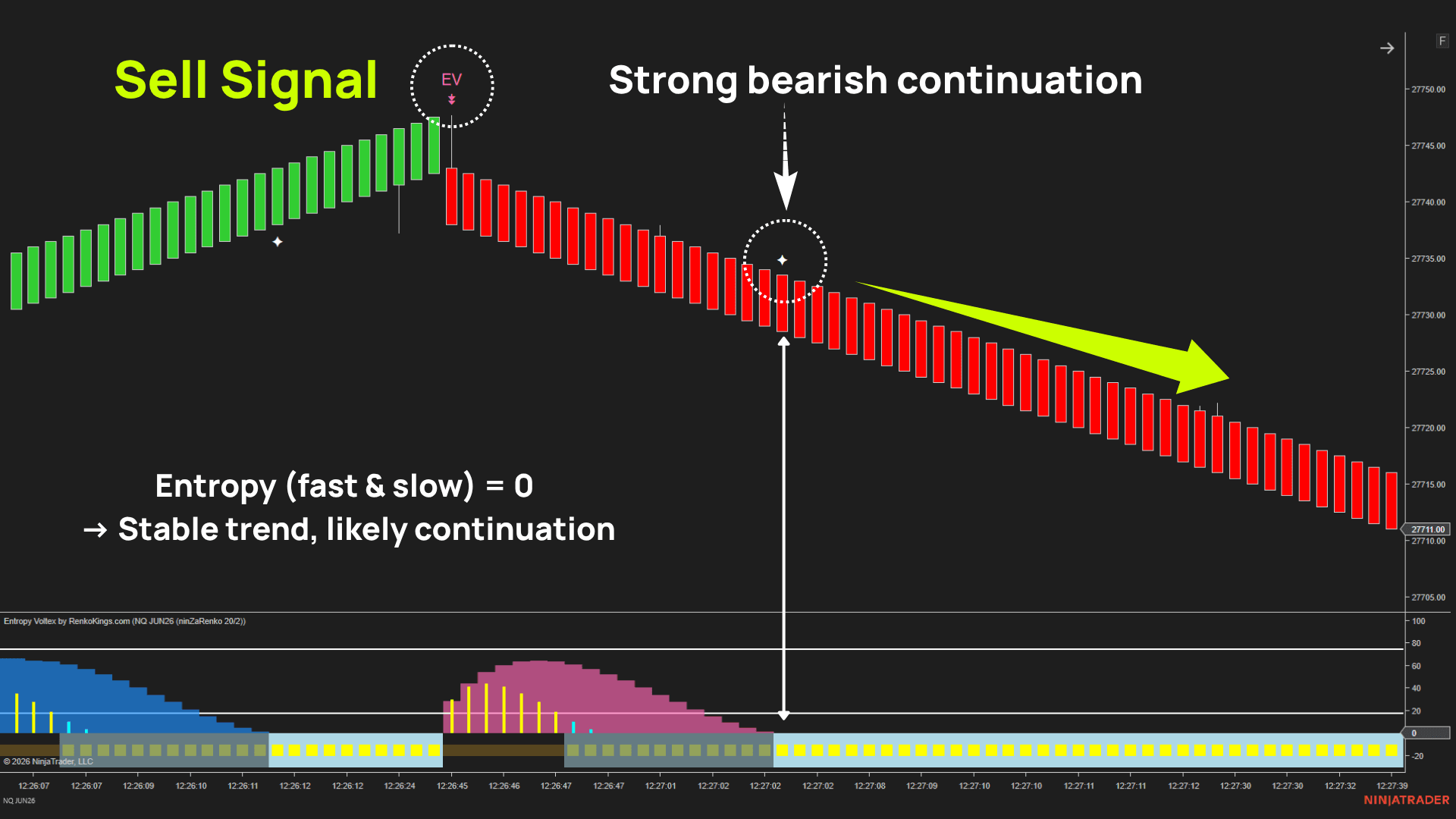
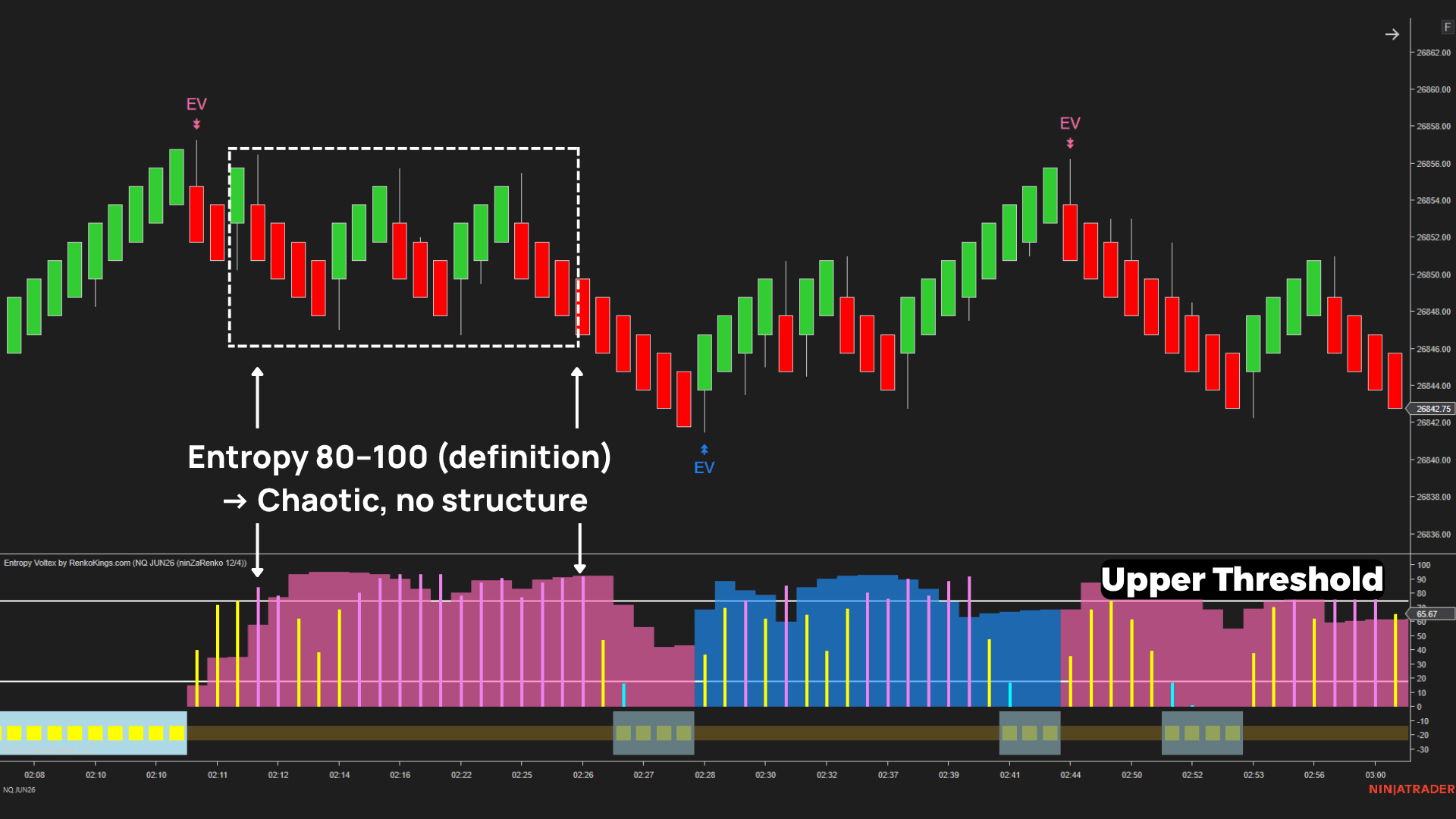
In information theory, entropy is a measure of uncertainty within a stream of information. Lower entropy indicates a more organized and predictable structure, while higher entropy reflects greater randomness and uncertainty.
Applied to financial markets, lower entropy suggests that consecutive price movements are behaving in a more consistent and directional manner. Higher entropy, on the other hand, indicates that price action has become increasingly fragmented, with movements that are less structured and more difficult to interpret. Traders often recognize these conditions as noisy or directionless markets.
This raises an important question:
“Why does market structure matter just as much as market direction?”
Because sustainable moves rarely emerge from randomness alone.
Before a meaningful breakout develops, the market often goes through a period of balance in which buyers and sellers repeatedly absorb each other’s orders within a relatively narrow range. During this phase, price may appear active, yet direction remains uncertain and movement lacks consistency.
As one side gradually gains control, price behavior begins to organize. The market transitions from a state of uncertainty toward a more directional structure, creating conditions where follow-through becomes more likely.
Entropy Voltex is designed to identify this transition – from disorder to order – rather than simply detecting whether price is moving up or down.
This is why Entropy Voltex measures the quality of price movement, not its direction.
A large bullish candle occurring during a highly disordered market may be nothing more than a temporary liquidity sweep before reversing. By contrast, a more modest move that occurs as market structure becomes increasingly organized often provides a more reliable foundation for trend continuation, even if it appears less dramatic on the chart.
The concept of entropy originates from Claude Shannon’s Information Theory, where entropy describes the level of uncertainty within an information source. In the context of financial markets, entropy provides a useful framework for describing the degree of order or unpredictability in price behavior.
Like any quantitative concept applied to trading, its practical value depends on how it is modeled, implemented, and validated against real market data.
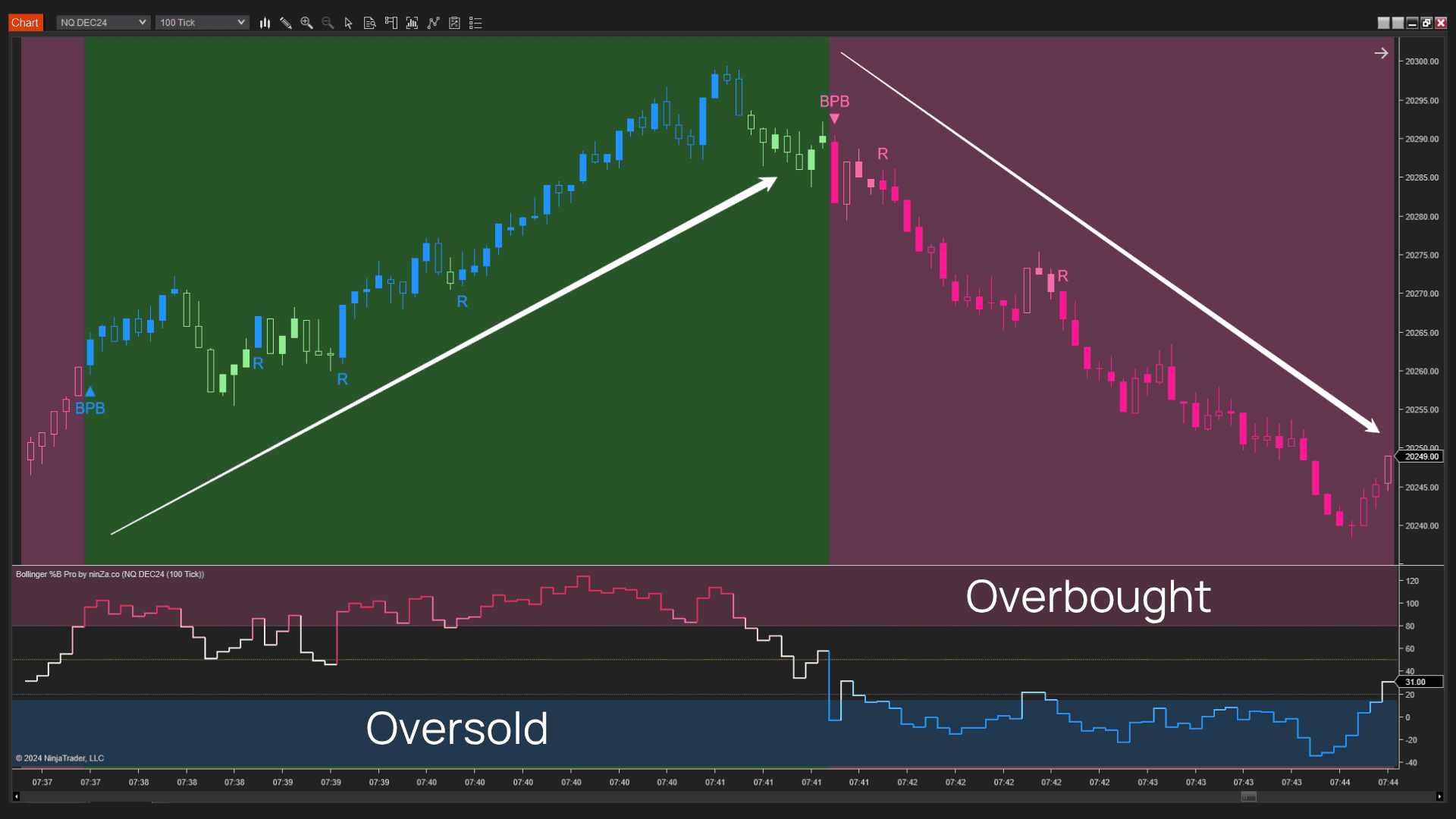
Bollinger %B measures the position of price relative to the Bollinger Bands.
A reading of 0 indicates price is at the lower band, while 1 indicates price is at the upper band. Values below 0 or above 1 suggest that price has moved beyond the bands – an indication that the move exceeds the market’s recent normal volatility range.
So why is Bollinger %B still necessary if Entropy Voltex has already confirmed that market conditions are favorable?
Because an orderly market isn’t necessarily a strong one.
A market can transition from disorder to order while still producing only limited price expansion. The structure may be reliable, but the move may simply lack enough momentum to travel far enough before conditions begin to deteriorate again.
This is where Bollinger %B Pro plays a different role.
Rather than evaluating the quality of market structure, it evaluates whether the current move has enough momentum to justify a scalping trade. In other words, it helps confirm that the move is not only reliable, but also capable of reaching realistic profit targets within the expected holding time.
The Pro version has also been refined to reduce false signals during narrow, low-volatility ranging markets.
The original %B can generate frequent upper- and lower-band readings even when overall price movement remains confined to a very small range. By requiring more meaningful price expansion before signaling, Bollinger %B Pro improves signal quality and reduces unnecessary entries.
Bollinger Bands, developed by John Bollinger, are adaptive volatility bands based on standard deviation. The bands widen as volatility increases and contract as volatility decreases, making %B an effective way to measure the relative position of price within the current volatility environment.
Like any technical indicator, however, Bollinger %B should not be interpreted as a standalone buy or sell signal. Its value comes from being combined with other independent information – in this case, direction from Noble Cloud and movement quality from Entropy Voltex.
These 3 indicators were not chosen simply because each performs well on its own. They were selected because each answers a different question that every high-quality trade should answer:
Together, they provide 3 independent forms of confirmation: direction, movement quality, and momentum.
When one of these dimensions is missing, the trade is far more likely to suffer from one of the entry problems discussed earlier.
More importantly, this framework gives you a practical way to diagnose why a trade failed – instead of simply concluding that the market didn’t behave as expected.
Complete playbook access
The remaining chapters, complete trading checklists, illustrated examples, chart templates, and practical application guidance are included with complete Expansion Entry Scalping Solution access.
Optional extensions
Expansion Entry Scalping Solution works on its own. These optional tools add systematic execution or a real-OHLC Renko foundation without changing the core entry framework.
Turn defined trading logic into a repeatable NinjaTrader workflow.
Best fit: Traders who want less manual intervention and more consistent rule-based execution.
Use a Renko bar built with real Open, High, Low, and Close data.
Best fit: Renko traders who want a backtest-ready chart foundation without giving up the familiar ninZaRenko workflow.
Complete Solution access
Optional extension access
Each extension is available separately. You do not need either one to use Expansion Entry Scalping Solution.
For traders who want to turn defined indicator logic into rule-based NinjaTrader execution.
Access Captain Optimus Strong v2 →
Apply coupon ZSUPPORT at checkout.
For Renko traders who want real OHLC data for backtesting and live trading.
Apply coupon ZSUPPORT at checkout.
October purchase assistance is available through October 31, 2026, subject to applicable program terms and the per-trader assistance limit.
Zuture Exchange coverage
Use Expansion Entry Scalping Solution in your own market conditions, chart setup, and real-time workflow for up to 30 days.
If the solution is not the right fit, you may request an exchange for another eligible product through Zuture Exchange.
Depending on the replacement selected, little or no additional investment may be required.